
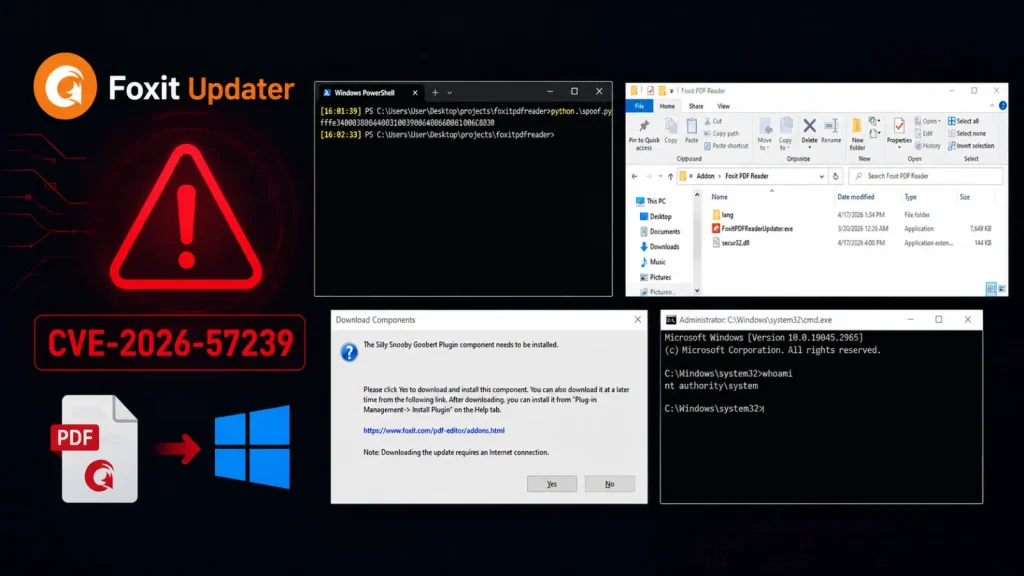
Foxit Updater Vulnerability Gives Standard Users SYSTEM-Level Control of Windows Devices
Foxit Updater Vulnerability: Standard Users Gain SYSTEM Control
In the complex landscape of endpoint security, a seemingly innocuous application can sometimes harbor a gateway to critical system compromise. Recent findings have shed light on a significant local privilege escalation vulnerability within Foxit PDF Reader’s updater mechanism. This flaw, enabling standard Windows users to achieve full SYSTEM-level control, presents a high-impact post-exploitation threat that demands immediate attention from IT professionals and security analysts.
Understanding the Foxit Updater Vulnerability (CVE-2026-57239)
Tracked as CVE-2026-57239, this vulnerability resides within the Foxit PDF Reader’s updater and its associated service architecture. While Foxit Reader is a widely used PDF viewing application, its underlying update process has been identified as a weak point. The core issue permits a standard, non-privileged Windows user, under specific conditions, to elevate their permissions to the highest level available on a Windows operating system: SYSTEM-level control.
This is particularly concerning because SYSTEM privileges grant an attacker complete and unrestricted access to the operating system, allowing them to:
- Execute arbitrary code with maximum privileges.
- Install malware or rootkits that are difficult to detect and remove.
- Modify system configurations, potentially disabling security measures.
- Create new administrative user accounts.
- Access sensitive data stored on the system.
The Mechanics of Post-Exploitation
The severity of CVE-2026-57239 lies in its potential as a post-exploitation pathway. This means that while a standard user cannot directly exploit this vulnerability to initiate an attack, if an attacker has already gained initial code execution on a target system (e.g., through a phishing attack, a drive-by download, or another separate vulnerability), they can then leverage this Foxit flaw to escalate their privileges. This escalation is often the critical next step for attackers looking to establish persistence, move laterally across a network, or inflict maximum damage.
The research into Foxit’s updater and service architecture likely uncovered a weakness in how the update service handles file operations or executes commands. Typically, update services run with elevated privileges to perform necessary system modifications. If these services are not robustly secured against malicious input or unexpected file paths, a lower-privileged process can trick them into performing actions that grant the lower-privileged process higher authority.
Impact and Risks for Organizations
For organizations relying on Foxit PDF Reader, the implications are substantial. This vulnerability transforms a potentially contained compromise of a standard user account into a full-scale system breach. The risks include:
- Data Exfiltration: SYSTEM-level access can facilitate the theft of sensitive corporate data.
- Network Penetration: Once SYSTEM access is achieved on one workstation, attackers can use it as a pivot point to compromise other systems and network resources.
- Persistent Foothold: Elevated privileges enable attackers to establish robust, hard-to-remove persistence mechanisms.
- Compliance and Regulatory Fines: Breaches stemming from such vulnerabilities can lead to significant financial penalties and reputational damage.
Remediation Actions and Best Practices
Addressing CVE-2026-57239 requires prompt and decisive action. Organizations should prioritize the following:
- Immediate Patching: Apply the latest security updates from Foxit as soon as they become available. Keep a vigilant eye on Foxit’s official security advisories.
- Principle of Least Privilege: Reinforce the principle of least privilege across all user accounts. Users should only have the minimum necessary permissions to perform their job functions.
- Application Whitelisting: Implement application whitelisting to prevent unauthorized executables from running, even if an attacker gains some level of access.
- Endpoint Detection and Response (EDR): Deploy and configure EDR solutions to monitor for suspicious activity, process anomalies, and privilege escalation attempts.
- Regular Security Audits: Conduct periodic security audits and vulnerability assessments to identify and remediate potential weaknesses before they can be exploited.
- User Awareness Training: Educate users about phishing, social engineering, and other initial access vectors to reduce the likelihood of the first stage of an attack.
Recommended Tools for Detection & Mitigation
| Tool Name | Purpose | Link |
|---|---|---|
| Foxit Reader Official Updates | Applying the official security patches from the vendor. | Foxit Security Bulletins |
| Endpoint Detection and Response (EDR) Solutions | Detecting and responding to anomalous process behavior and privilege escalation attempts. (e.g., CrowdStrike Falcon, SentinelOne, Microsoft Defender for Endpoint) | Vendor-specific links (example: CrowdStrike) |
| Vulnerability Scanners | Identifying unpatched software and potential misconfigurations across endpoints. (e.g., Tenable Nessus, Qualys, Rapid7 InsightVM) | Vendor-specific links (example: Nessus) |
| Application Control Software | Enforcing application whitelisting and preventing unauthorized code execution. (e.g., Microsoft AppLocker, Ivanti Application Control) | Vendor-specific links (example: Microsoft WDAC) |
Conclusion
The disclosure of CVE-2026-57239 underscores the critical importance of a multi-layered security approach. While no vulnerability exists in isolation, a flaw that allows standard users to gain SYSTEM-level access transforms a contained incident into a severe breach. Proactive patching, strict adherence to the principle of least privilege, and robust endpoint security measures are essential to mitigate the risks posed by such high-impact vulnerabilities.




