
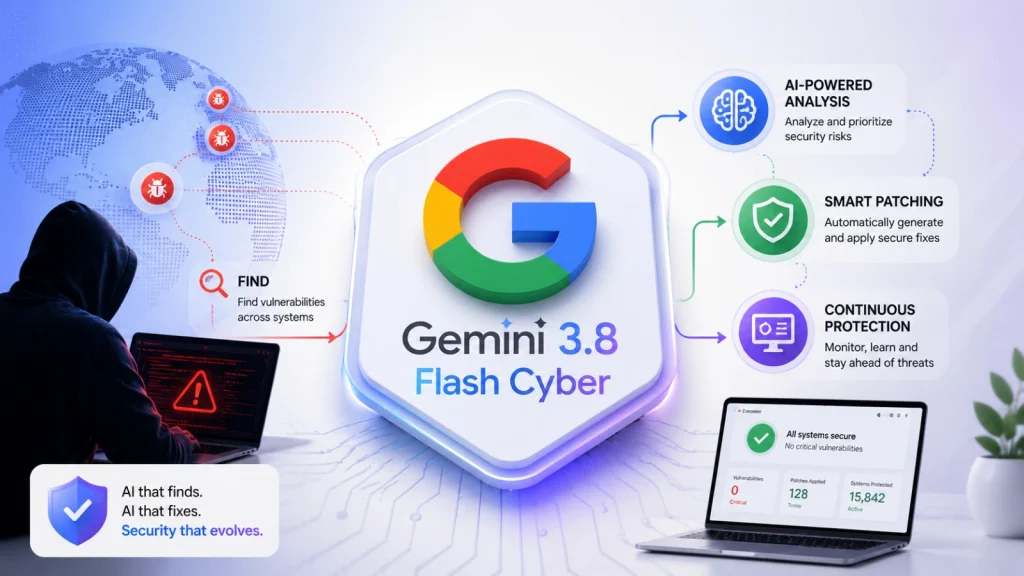
Google Launches Gemini 3.8 Flash Cyber to Identify and Auto-Patch Security Vulnerabilities
Google Gemini 3.8 Flash Cyber: Revolutionizing Software Security
The landscape of cybersecurity is undergoing a significant transformation, driven by advancements in artificial intelligence. Google has recently unveiled a groundbreaking development in this arena: Gemini 3.8 Flash Cyber. This specialized variant of their latest reasoning and coding model, Gemini 3.8, is engineered to autonomously identify software vulnerabilities and, remarkably, generate functional patches to address them. This release, arriving swiftly after Gemini 3.7 Flash, underscores Google’s aggressive pace in AI innovation and its strategic focus on bolstering digital defenses.
Understanding Gemini 3.8 Flash Cyber’s Core Capabilities
Gemini 3.8 Flash Cyber represents a leap forward in automated security. Unlike traditional vulnerability scanners that primarily detect known weaknesses, this AI model is designed for deep code analysis and intelligent pattern recognition. Its core capabilities include:
- Autonomous Vulnerability Discovery: Gemini 3.8 Flash Cyber can analyze source code, bytecode, and even compiled binaries to uncover novel vulnerabilities, not just those already documented in databases like the National Vulnerability Database (NVD). This includes common weaknesses such as SQL injection, cross-site scripting (XSS), buffer overflows, and insecure direct object references.
- Working Patch Generation: Perhaps the most revolutionary aspect is its ability to create functional code patches. This moves beyond simply identifying issues to actively providing solutions, significantly reducing the time and resources typically required for manual remediation by development teams.
- Reasoning and Coding Excellence: Built upon the Gemini 3.8 family, Flash Cyber inherits superior reasoning and coding abilities, enabling it to understand complex software logic and apply nuanced fixes. This ensures that generated patches are not only effective but also maintain code integrity and functionality.
The Impact on Software Development and Security Operations
The introduction of Gemini 3.8 Flash Cyber carries profound implications for both software development lifecycles (SDLC) and security operations (SecOps). For developers, it offers the potential for significantly faster and more secure code deployment. By integrating such a tool into continuous integration/continuous delivery (CI/CD) pipelines, vulnerabilities could be identified and patched almost in real-time, shifting security left in the development process more effectively than ever before.
For security analysts, Gemini 3.8 Flash Cyber could alleviate the burden of manual code review and vulnerability research, allowing them to focus on more complex threat intelligence and strategic security initiatives. The automation of patch generation could drastically reduce mean time to remediate (MTTR) for discovered vulnerabilities, strengthening an organization’s overall security posture against emerging threats.
Case Study: Addressing a Hypothetical Vulnerability (e.g., CVE-2023-XXXXX)
Consider a hypothetical scenario where a critical vulnerability, such as an arbitrary code execution flaw designated CVE-2023-12345, is present in a widely used open-source library. Traditional methods would involve security researchers discovering the flaw, reporting it, and then developers manually coding and testing a patch. With Gemini 3.8 Flash Cyber, the process could be dramatically accelerated. The AI could identify the specific code segments leading to the vulnerability and then generate a robust, tested patch to mitigate CVE-2023-12345, all within a fraction of the time, potentially before malicious actors can exploit it.
Remediation Actions and Best Practices
While Gemini 3.8 Flash Cyber offers advanced automated solutions, organizations must still adopt comprehensive security strategies. Here are key remediation actions and best practices:
- Integrate Automated Security Tools: Incorporate AI-powered tools like Gemini 3.8 Flash Cyber into your CI/CD pipelines to catch vulnerabilities early.
- Regular Security Audits: Supplement automated analysis with periodic manual code reviews and penetration testing.
- Maintain Software Hygiene: Regularly update all software, libraries, and frameworks to their latest secure versions.
- Developer Training: Educate developers on secure coding practices to reduce the introduction of vulnerabilities from the outset.
- Incident Response Plan: Establish and regularly test a robust incident response plan for when vulnerabilities are exploited.
Tools for Vulnerability Management and Analysis
Even with advanced AI like Gemini 3.8 Flash Cyber, a holistic approach to security requires a suite of tools. Here’s a table of relevant tools that complement AI-driven vulnerability management:
| Tool Name | Purpose | Link |
|---|---|---|
| OWASP ZAP | Dynamic Application Security Testing (DAST) | https://www.zaproxy.org/ |
| SonarQube | Static Application Security Testing (SAST) & Code Quality | https://www.sonarqube.org/ |
| Nessus | Vulnerability Scanning and Assessment | https://www.tenable.com/products/nessus |
| Metasploit Framework | Penetration Testing & Exploit Development | https://www.metasploit.com/ |
Conclusion: The Future of Proactive Cybersecurity
Google’s introduction of Gemini 3.8 Flash Cyber marks a pivotal moment for cybersecurity. Its ability to autonomously discover vulnerabilities and generate working patches signifies a significant shift towards more proactive and automated security measures. While human oversight and strategic security planning remain indispensable, this AI innovation promises to dramatically enhance our ability to defend against software weaknesses, making digital environments inherently more secure. This development is not just about faster patching; it represents a fundamental re-evaluation of how we approach software security, pushing towards a future where vulnerabilities are identified and neutralized with unprecedented speed and efficiency.




