
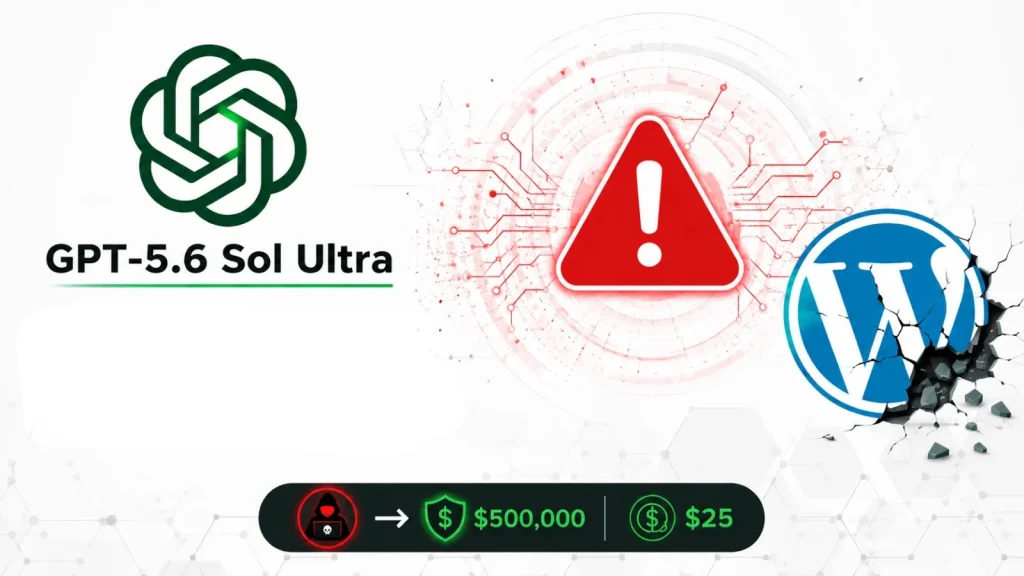
GPT-5.6 Sol Ultra Found Wp2shell RCE Flaw That Could Be Worth $500,000 for About $25
AI’s Alarming Breakthrough: GPT-5.6 Sol Ultra Uncovers WP2Shell RCE for a Mere $25
The landscape of cybersecurity is undergoing a rapid transformation, and a recent development has sent ripples through the industry, underscoring the formidable capabilities of Artificial Intelligence. Imagine a scenario where a cutting-edge AI, for the cost of a few premium coffees, unearths a critical vulnerability in one of the internet’s most widely used platforms. This isn’t a dystopian fantasy; it’s the reality unveiled by GPT-5.6 Sol Ultra, which reportedly discovered a pre-authentication Remote Code Execution (RCE) flaw in WordPress, a vulnerability potentially valued at half a million dollars, for an investment of approximately $25 in AI compute time. This event, initially reported by Cybersecurity News, heralds a new era in vulnerability research, where AI-driven analysis might soon outpace traditional methods.
The WP2Shell RCE Vulnerability Explained
The core of this groundbreaking discovery lies in a Remote Code Execution (RCE) vulnerability, specifically dubbed “WP2Shell.” RCE flaws are among the most severe security vulnerabilities because they allow an attacker to execute arbitrary code on a compromised server. In the context of WordPress, which powers over 40% of all websites, a pre-authentication RCE means an attacker could exploit the vulnerability without needing to log in or have any prior access credentials. This greatly expands the attack surface, making countless websites susceptible to complete takeover.
While specific details about the WP2Shell exploit mechanism are still emerging, an RCE typically leverages flaws in how an application handles user input, file uploads, or deserialization processes. An attacker could craft malicious input that, when processed by the vulnerable WordPress instance, executes commands directly on the underlying server. This could lead to data theft, website defacement, server compromise, and potentially the deployment of ransomware or other malware.
How GPT-5.6 Sol Ultra Made This Discovery
The methodology behind GPT-5.6 Sol Ultra’s success is as compelling as the discovery itself. Researchers at Searchlight Cyber tasked this advanced AI model with a seemingly straightforward objective: audit a local copy of the WordPress source code. What’s particularly innovative is the approach: instead of a single monolithic AI, they employed four distinct AI agents working concurrently. These agents likely specialized in different aspects of code analysis, such as identifying input validation weaknesses, scrutinizing file handling functions, and understanding potential command injection points. By operating in concert, these AI agents could collectively pinpoint subtle architectural flaws and logical errors that might escape human review or even automated static analysis tools not specifically designed for such deep contextual understanding.
The reported cost of approximately $25 for this analysis further underscores the efficiency and potential cost-effectiveness of AI in vulnerability research. This low barrier to entry for such a high-value discovery suggests a future where AI tools could democratize vulnerability hunting, making advanced security audits accessible to a broader range of organizations.
The Half-Million Dollar Question: Value and Impact
A $500,000 valuation for this RCE flaw is not an arbitrary figure. Such a price often reflects the potential for significant financial gain or strategic advantage that a threat actor could derive from exploiting the vulnerability. For a critical flaw in a widely used platform like WordPress, the implications are vast:
- Widespread Compromise: Millions of websites could be at risk, leading to widespread data breaches, content manipulation, and service disruptions.
- Black Hat Market Value: In underground markets, a pre-authentication RCE in a popular CMS is a highly prized asset, enabling mass exploitation campaigns.
- Nation-State Operations: Such vulnerabilities can be leveraged by state-sponsored actors for espionage, propaganda, or critical infrastructure disruption.
- Ransomware Deployment: Attackers could deploy ransomware across numerous WordPress sites, extorting large sums from affected organizations.
The discovery thus highlights not only the power of AI but also the ongoing, high-stakes battle against sophisticated cyber threats.
As this is a newly discovered vulnerability, a specific CVE ID for this particular WP2Shell flaw may still be pending assignment. Security researchers and WordPress core developers will undoubtedly be working to assign the correct identifier and release patches. Users should regularly check official WordPress security announcements for updates.
Remediation Actions for WordPress Users
While specific patches for the WP2Shell RCE are awaited, here are crucial remediation actions every WordPress site administrator should undertake to bolster their security posture:
- Immediate WordPress Core Updates: Always run the latest version of WordPress. As soon as a patch is released for this vulnerability, update immediately.
- Plugin and Theme Updates: Ensure all installed plugins and themes are also up-to-date. Vulnerabilities in these components can often be an entry point.
- Principle of Least Privilege: Review user roles and permissions, ensuring no user or process has more access than strictly necessary.
- Web Application Firewall (WAF): Implement a robust WAF to detect and block malicious traffic patterns and known exploit attempts. Configure it to be as proactive as possible.
- Regular Backups: Maintain frequent and secure backups of your entire WordPress site (files and database) in an offsite location. This is crucial for recovery in case of compromise.
- Security Scanning: Utilize security scanning tools to regularly check your WordPress site for known vulnerabilities, corrupted files, and suspicious activity.
- Strong Passwords and Two-Factor Authentication (2FA): Enforce strong, unique passwords for all user accounts and enable 2FA for administrators and editors.
Tools for Detection and Mitigation
To aid in detecting potential compromises and enhancing overall WordPress security, various tools can be invaluable:
| Tool Name | Purpose | Link |
|---|---|---|
| Sucuri Security | Website monitoring, malware scanning, WAF | https://sucuri.net/ |
| Wordfence Security | Endpoint firewall, malware scanner, login security | https://www.wordfence.com/ |
| Cloudflare | CDN, DDoS protection, WAF | https://www.cloudflare.com/ |
| WPScan | WordPress vulnerability scanner (CLI tool) | https://wpscan.com/ |
| Qualys Web Application Scanning | Comprehensive web app vulnerability assessment | https://www.qualys.com/apps/web-application-scanning/ |
The Future of AI in Cybersecurity Research
The GPT-5.6 Sol Ultra incident is not an isolated event but a preview of what’s to come. AI models are rapidly evolving, moving beyond simple pattern recognition to more complex contextual understanding and code analysis. This advancement suggests several key trends for the future of cybersecurity:
- Accelerated Vulnerability Discovery: AI will dramatically reduce the time and cost associated with finding critical vulnerabilities, potentially leading to a deluge of newly identified flaws.
- Shift in Security Job Roles: While some fear job displacement, AI is more likely to augment human capabilities, allowing security analysts to focus on higher-level strategy, threat intelligence, and complex incident response, rather than tedious manual code review.
- AI-on-AI Warfare: The inevitable consequence will be AI-powered offensive tools developed by threat actors, countered by equally sophisticated AI defense mechanisms.
- Ethical Considerations: The capability of AI to autonomously discover high-impact vulnerabilities raises ethical questions about responsible disclosure, the potential for misuse, and the need for robust AI safety guidelines.
Key Takeaways
The revelation that GPT-5.6 Sol Ultra, for a mere $25, uncovered a pre-authentication RCE flaw in WordPress with an estimated value of $500,000 is a watershed moment in cybersecurity. It highlights the unprecedented efficiency and analytical depth that advanced AI models bring to vulnerability research. For WordPress users, the emphasis remains on vigilance, prompt updates, and a multi-layered security strategy. For the broader cybersecurity community, this event signals a critical shift, urging a proactive embrace of AI as a powerful ally in the perpetual cat-and-mouse game against cyber threats, while simultaneously preparing for the sophisticated challenges AI-driven attacks will present.




