
Hackers Are Turning Microsoft 365 Calendar Invites Into Secret Malware Command Channels
The Calendar Covert: How Hackers Are Hijacking Microsoft 365 Invites for Malware Command and Control
The digital workspace, bustling with team meetings and project deadlines, often takes the form of our Microsoft 365 calendars. But what if these seemingly innocuous scheduling tools were secretly orchestrating something far more sinister? A new and stealthy threat actor is leveraging Microsoft 365 calendar invites not for collaboration, but for covert command and control of malware. This sophisticated technique marks a significant escalation in evasion tactics, making detection and defense increasingly challenging for security teams.
As cybersecurity analysts, our focus is ever on the evolving landscape of threats. This report delves into the mechanics of this novel attack, spearheaded by a malware strain dubbed HOLLOWGRAPH, and provides essential insights for IT professionals and security analysts to bolster their defenses against this insidious new approach.
Introducing HOLLOWGRAPH: The Calendar-Based Malware
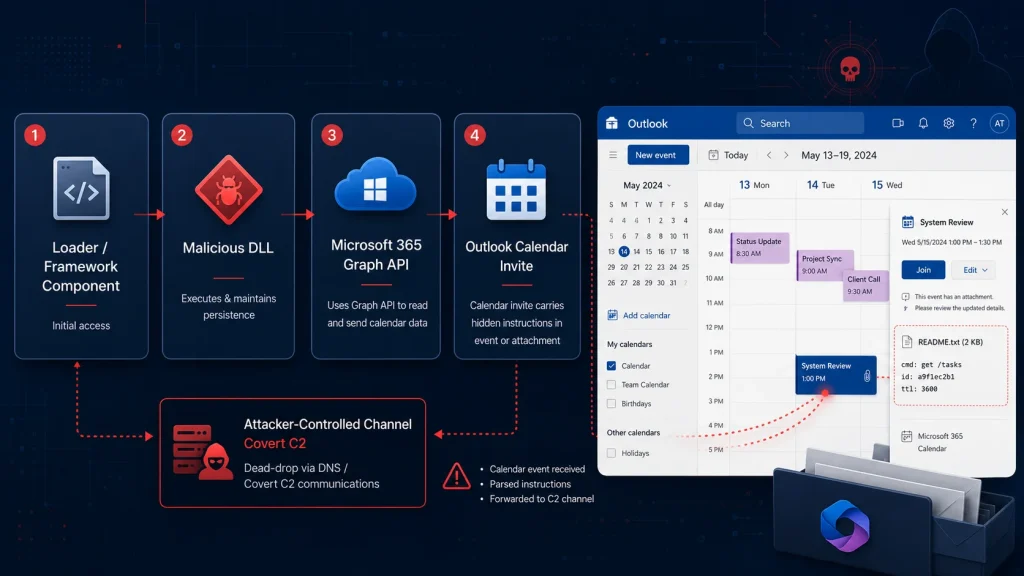
At the center of this new threat is HOLLOWGRAPH, a meticulously crafted .NET-compiled malware component. What makes HOLLOWGRAPH particularly dangerous is its ingenious method of communication: it completely bypasses traditional command-and-control (C2) channels by abusing the Microsoft Graph API. Instead of relying on external C2 servers that might be flagged by network defenders, HOLLOWGRAPH transforms a compromised Microsoft 365 mailbox’s calendar into a two-way “dead drop” for malicious commands and exfiltrated data.
This means that legitimate calendar invitations, complete with meeting times, attendees, and subject lines, are being weaponized. The malware interprets specific, embedded instructions within these invites, effectively turning a common organizational tool into a secret communication relay for attackers. This technique is incredibly stealthy, as the traffic appears to be normal Microsoft Graph API calls related to calendar management, blending seamlessly with legitimate network activity.
The Mechanics of a Stealthy Compromise
The process begins with the compromise of a Microsoft 365 account. This initial foothold could be gained through various means, including phishing, credential stuffing, or exploiting vulnerabilities in associated applications. Once an attacker has access to a user’s mailbox, HOLLOWGRAPH leverages this access to interact with the Microsoft Graph API. The Microsoft Graph API is a powerful interface that allows applications to access and manage Microsoft 365 data, including calendars, emails, and files.
HOLLOWGRAPH creates calendar events with specific, encoded instructions or data. These events can appear completely normal to an casual observer, making them incredibly difficult to distinguish from legitimate entries. For instance, the subject line, location field, or even attendee lists could contain encrypted commands or data fragments. The malware then periodically queries the compromised calendar for these specially formatted entries, executing the contained commands or exfiltrating data by embedding it into new calendar invites to be “read” by the attacker.
This method offers several advantages to attackers:
- Evasion: Traditional network intrusion detection systems (IDS) and firewalls are unlikely to flag legitimate-looking calendar traffic.
- Persistence: The communication channel can remain active as long as the compromised account maintains access.
- Authentication: Leveraging a legitimate Microsoft 365 account provides inherent authentication, further obscuring malicious activity.
Remediation Actions and Detection Strategies
Given the sophisticated nature of HOLLOWGRAPH, a multi-layered defense strategy is paramount. Organizations must shift their focus to insider threats and the compromise of legitimate credentials, as these are the initial points of entry for such attacks.
Proactive Measures:
- Strong Authentication Policies: Implement and enforce Multi-Factor Authentication (MFA) for all Microsoft 365 accounts, especially administrator accounts. This acts as a critical barrier against compromised credentials.
- Employee Training: Conduct regular security awareness training, highlighting the dangers of phishing and social engineering tactics that lead to credential theft.
- Principle of Least Privilege: Ensure users and applications only have the necessary permissions to perform their job functions. Regularly review and revoke unnecessary access.
- API Monitoring: Implement robust monitoring of Microsoft Graph API activity. Look for unusual patterns of calendar event creation, modification, or deletion, especially from non-standard IP addresses or at unusual times.
- Endpoint Detection and Response (EDR): Deploy EDR solutions that can detect suspicious process behavior, registry modifications, and file system changes indicative of malware presence, even if initial network traffic appears legitimate.
Detection and Response:
- Log Analysis: Regularly analyze Microsoft 365 audit logs for unusual activity related to calendar events, particularly consistent patterns of event creation/deletion by a single user or application that doesn’t align with their typical behavior.
- Behavioral Analytics: Utilize security information and event management (SIEM) systems with behavioral analytics capabilities. These can identify deviations from baseline user behavior, such as a user suddenly creating a large number of calendar events with unusual titles or metadata.
- Threat Hunting: Proactively search for indicators of compromise (IOCs) associated with HOLLOWGRAPH or similar calendar-based C2 techniques. This might involve looking for specific string patterns in calendar event descriptions or unusual API calls.
- Incident Response Plan: Have a well-defined incident response plan in place for compromised Microsoft 365 accounts, including steps for isolating the account, revoking access tokens, and initiating forensic analysis.
Tools for Detection and Mitigation
Effective defense against HOLLOWGRAPH requires a combination of robust security tools. The following table outlines some key tool categories and examples:
| Tool Name/Category | Purpose | Link |
|---|---|---|
| Microsoft 365 Defender | Comprehensive security suite for Microsoft 365, including identity protection, endpoint security, and cloud app security. | https://www.microsoft.com/en-us/security/business/microsoft-365-defender |
| SIEM Solutions (e.g., Splunk, Microsoft Sentinel) | Centralized log management and security information and event management for detecting anomalies and correlation. | https://www.splunk.com https://azure.microsoft.com/en-us/products/microsoft-sentinel |
| Endpoint Detection and Response (EDR) Platforms | Advanced threat detection, investigation, and response at the endpoint level. | (Various vendors, e.g., CrowdStrike, SentinelOne) |
| Cloud Access Security Brokers (CASB) | Monitor and enforce security policies for cloud applications, providing visibility into Microsoft 365 activity. | (Various vendors, e.g., Zscaler, Palo Alto Networks) |
| Security Awareness Training Platforms | Educate employees on phishing, social engineering, and secure practices. | (Various vendors, e.g., KnowBe4, Proofpoint) |
Conclusion: Strengthening Your Microsoft 365 Defenses
The emergence of HOLLOWGRAPH underscores an important trend in cybersecurity: attackers will continually innovate to find new, stealthy channels for their malicious activities. By leveraging seemingly harmless tools like Microsoft 365 calendar invites, they increase their chances of evading traditional security measures. For security professionals, this means a constant need to adapt and expand monitoring capabilities beyond conventional network perimeters.
A proactive security posture, emphasizing strong authentication, continuous monitoring of API activity, robust employee training, and the intelligent use of security tools, is no longer optional but essential. By understanding the mechanisms behind threats like HOLLOWGRAPH, organizations can build more resilient defenses and safeguard their critical digital assets.




