
Hackers Can Turn Off Refrigeration While the Temperature Display Still Looks Normal
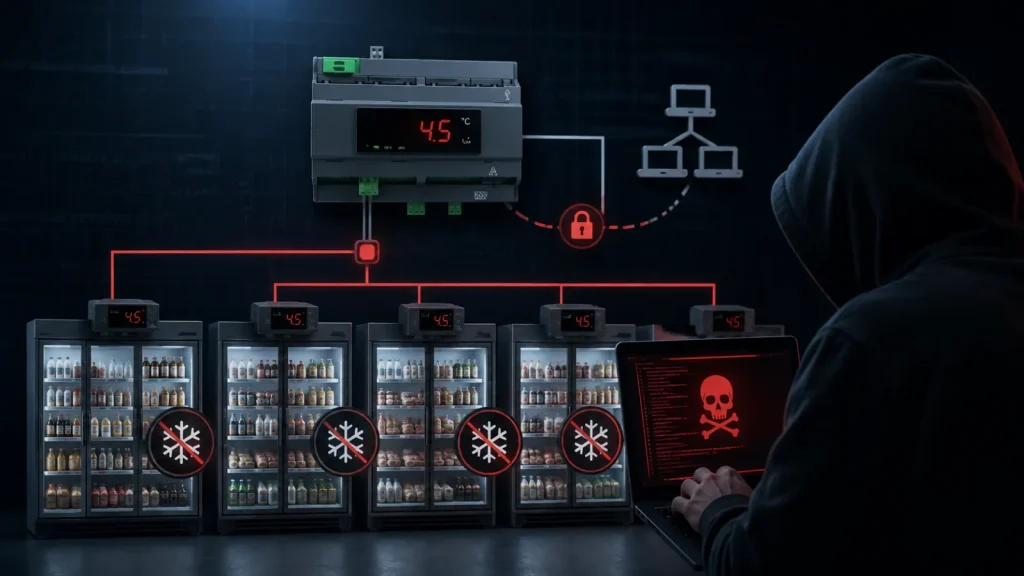
Imagine shelves of produce wilting, vaccines spoiling, or critical lab samples degrading, all while the temperature display proudly assures you everything is perfectly chilled. This isn’t a scene from a dystopian thriller; it’s a very real and concerning vulnerability uncovered in widely used commercial refrigeration systems. The Claroty Team82 research unit has shed light on a critical flaw: hackers can remotely manipulate refrigeration units, not just turning them off, but also falsifying temperature readings to mask their attack.
The Chilling Reality: Vulnerabilities in Commercial Refrigeration
The core of this issue lies within Copeland’s XWEB Pro supervisory controllers. These devices are the nerve center for commercial refrigeration in a vast array of critical environments, including supermarkets, food warehouses, and even hospitals. Claroty Team82’s in-depth analysis revealed 23 distinct vulnerabilities within these controllers. A staggering 21 of these are rated as high severity.
What makes these vulnerabilities particularly alarming is their collective impact: they allow an unauthenticated attacker to gain full root-level control of the device over the network. This means an attacker doesn’t need to steal credentials or exploit complex bypasses; a direct network connection can be enough to compromise these systems entirely.
Understanding the Threat: What Full Root Access Means
Gaining “full root-level control” is the cybersecurity equivalent of being handed the master key to a system. For a Copeland XWEB Pro controller, this level of access translates to an attacker’s ability to:
- Completely disable refrigeration units: Products spoil, critical supplies are ruined.
- Manipulate temperature displays: The most insidious aspect, as operators would be oblivious to the actual temperature rise until it’s too late.
- Modify operational parameters: Changing fan speeds, defrost cycles, or alarm thresholds without detection.
- Deploy malicious code: Using the controller as a pivot point to compromise other systems on the network.
- Install backdoors: Ensuring persistent access even after an initial attack is detected and addressed.
The potential for widespread damage, financial loss, and even public health risks is immense. Consider a hospital’s blood bank or a pharmaceutical warehouse; the impact of compromised refrigeration in such settings is catastrophic.
Key Vulnerabilities and Their Impact
While the full list of 23 vulnerabilities is extensive, their collective impact is a critical concern. Several of these high-severity flaws contribute to the overarching ability to gain root access and manipulate operations. For instance, vulnerabilities like CVE-2023-38662, a critical authentication bypass, could be instrumental in establishing initial access. Further vulnerabilities could then be chained together to escalate privileges and achieve full control.
The specific CVEs identified by Claroty Team82 highlight various attack vectors, including command injection, improper authentication, and insecure communication protocols. These types of vulnerabilities are common in embedded systems that may not have received the same level of security scrutiny as traditional IT infrastructure.
Remediation Actions
Addressing these vulnerabilities in Copeland XWEB Pro supervisory controllers is paramount for any organization utilizing them. Immediate and proactive measures are essential to prevent potential exploitation:
- Patching and Firmware Updates: The absolute first step is to apply all available patches and firmware updates released by Copeland. These updates will directly address the identified vulnerabilities. Organizations should establish a regular patching schedule for all OT/ICS devices.
- Network Segmentation: Isolate refrigeration control networks from the broader corporate network. Implement strict firewall rules to limit communication to only essential services and authorized personnel. This minimizes the attack surface.
- Strong Access Controls: Enforce strong, unique passwords for all accounts. Implement multi-factor authentication (MFA) wherever possible, especially for remote access. Regularly review and revoke unnecessary user privileges.
- Monitoring and Alerting: Deploy network intrusion detection/prevention systems (IDPS) and security information and event management (SIEM) solutions to monitor network traffic for suspicious activity related to these controllers. Configure alerts for unusual access patterns, configuration changes, or abnormal temperature readings.
- Physical Security: Ensure physical access to controllers is restricted. While many of these vulnerabilities are network-based, physical access can lead to direct compromise.
- Vendor Communication: Maintain open communication with Copeland and stay informed about future security advisories and recommended best practices.
Detection and Mitigation Tools
Leveraging appropriate tools is crucial for identifying potential compromises and strengthening defenses against these types of vulnerabilities.
| Tool Name | Purpose | Link |
|---|---|---|
| Claroty Continuous Threat Detection (CTD) | OT/ICS network monitoring, vulnerability management, threat detection | https://claroty.com/platform/claroty-ctd/ |
| Tenable.ot | Vulnerability management and threat detection for OT environments | https://www.tenable.com/products/tenable-ot |
| Dragos Platform | Industrial cybersecurity platform for threat detection and response | https://www.dragos.com/platform/ |
| Wireshark | Network protocol analyzer for deep packet inspection and anomaly detection | https://www.wireshark.org/ |
| Nmap (Network Mapper) | Network discovery and security auditing for identifying open ports and services | https://nmap.org/ |
Conclusion
The discovery of critical vulnerabilities in Copeland XWEB Pro controllers underscores a fundamental challenge in industrial control systems: the potential for seemingly innocuous devices to become significant attack vectors. The ability for an unauthenticated attacker to gain full root access and manipulate critical functions, including falsifying temperature readings, presents a severe risk to various sectors. Proactive patching, robust network segmentation, strong access controls, and continuous monitoring are not merely best practices but essential defense strategies against such sophisticated threats. Organizations must treat the security of their OT environments with the same rigor applied to traditional IT infrastructure.




