
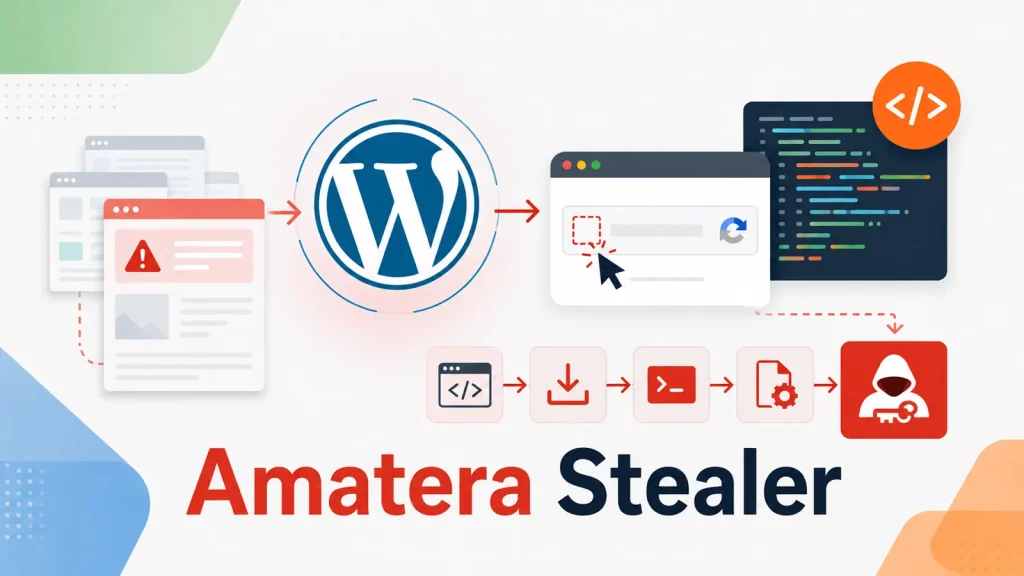
Hackers Compromise Hundreds of WordPress Sites to Deploy Amatera Stealer via ClickFix
The Silent Compromise: Amatera Stealer Infiltrates WordPress Sites via ClickFix
The digital landscape is a constant battleground, and a recent campaign highlights the sophisticated tactics employed by threat actors. Hundreds of WordPress sites have been compromised, serving as unwitting hosts for the distribution of the insidious Amatera Stealer. This operation leverages a deceptive “ClickFix” mechanism, demonstrating a concerning trend of supply chain attacks targeting widely used platforms.
Understanding the Amatera Stealer Threat
The Amatera Stealer is a malicious software designed to pilfer sensitive information from infected systems. Its capabilities typically include harvesting credentials, financial data, browsing history, and other personal information. The impact of such a stealer can be devastating, leading to identity theft, financial fraud, and further system compromise. The current campaign’s use of compromised WordPress sites as a delivery vector significantly amplifies its reach and potential for harm.
The Deceptive ClickFix Mechanism
While the initial report doesn’t detail the exact nature of “ClickFix,” the context suggests it’s a compromised plugin, theme, or a malicious script injected into legitimate WordPress sites. This allows threat actors to silently embed the Amatera Stealer payload. Users visiting these compromised sites, often unsuspecting of the underlying threat, are then exposed to the stealer’s deployment. This method bypasses traditional email-based phishing and targets the trust users place in established websites.
Targeting Researchers with a Fake Resume Lure
Adding another layer of deception, this campaign specifically targets researchers using a meticulously crafted social engineering tactic. Threat actors are deploying a remote-access tool (RAT) on researchers’ Windows computers through a fake student resume. The malicious payload is disguised within an archive, appearing to be a graduate-school application. Upon execution, a genuine Word document opens, distracting the user while the infection quietly unfolds in the background. The lure claims to originate from Beijing, lending a false sense of legitimacy to the attack. This highlights the sophisticated pre-attack reconnaissance and targeting capabilities of the adversaries.
Supply Chain Implications for WordPress Ecosystem
The compromise of hundreds of WordPress sites to distribute malware underscores the critical importance of supply chain security within the web ecosystem. WordPress, being the most popular content management system, is a prime target. Malicious actors frequently exploit vulnerabilities in plugins, themes, or even the core software to gain unauthorized access and use these platforms for nefarious purposes. This particular incident serves as a stark reminder that even seemingly secure websites can become vectors for malware distribution if not properly maintained and protected.
Remediation Actions for WordPress Administrators and Users
Protecting against threats like the Amatera Stealer requires a multi-faceted approach. Both site administrators and end-users play crucial roles:
- For WordPress Administrators:
- Regularly Update Everything: Ensure your WordPress core, themes, and plugins are always updated to the latest versions. Patches often address critical security vulnerabilities.
- Implement Strong Security Plugins: Utilize reputable security plugins for firewalls, malware scanning, and intrusion detection.
- Monitor Website Activity: Regularly check your website logs for unusual activity, unauthorized file modifications, or suspicious outbound connections.
- Use Strong Passwords and Two-Factor Authentication (2FA): Enforce complex passwords for all user accounts and enable 2FA for administrators.
- Regular Backups: Maintain regular, off-site backups of your entire WordPress installation. This allows for swift recovery in case of a compromise.
- Audit Third-Party Components: Exercise caution when installing new themes or plugins. Verify their legitimacy and review their code if possible.
- For End-Users:
- Exercise Caution with Downloads: Be highly suspicious of unsolicited attachments or downloads, especially those from unknown senders or unexpected contexts (like a resume in an unusual email).
- Keep Software Updated: Ensure your operating system, web browser, and antivirus software are always up-to-date.
- Use Reputable Antivirus/Endpoint Protection: Employ a robust security solution that can detect and prevent malware execution.
- Practice Good Cyber Hygiene: Avoid clicking on suspicious links and be wary of social engineering tactics.
Detection and Mitigation Tools
Various tools can assist in detecting and mitigating such threats:
| Tool Name | Purpose | Link |
|---|---|---|
| Wordfence Security | WordPress Firewall & Malware Scanner | https://www.wordfence.com/ |
| Sucuri Security | Website Security, Malware Removal, DDoS Protection | https://sucuri.net/ |
| Malwarebytes | Endpoint Protection, Malware Detection & Removal | https://www.malwarebytes.com/ |
| VirusTotal | Analyze suspicious files and URLs for malware | https://www.virustotal.com/ |
Conclusion: Vigilance is Key
The Amatera Stealer campaign, leveraging compromised WordPress sites and sophisticated social engineering, underscores the evolving threat landscape. The use of a fake student resume to deploy remote-access tools on researchers’ systems highlights the targeted and persistent nature of these attacks. For both site administrators and individual users, continuous vigilance, robust security practices, and timely updates are paramount to defending against such pervasive and damaging threats. Staying informed about the latest attack vectors and implementing strong preventative measures are essential in securing our digital ecosystems.




