
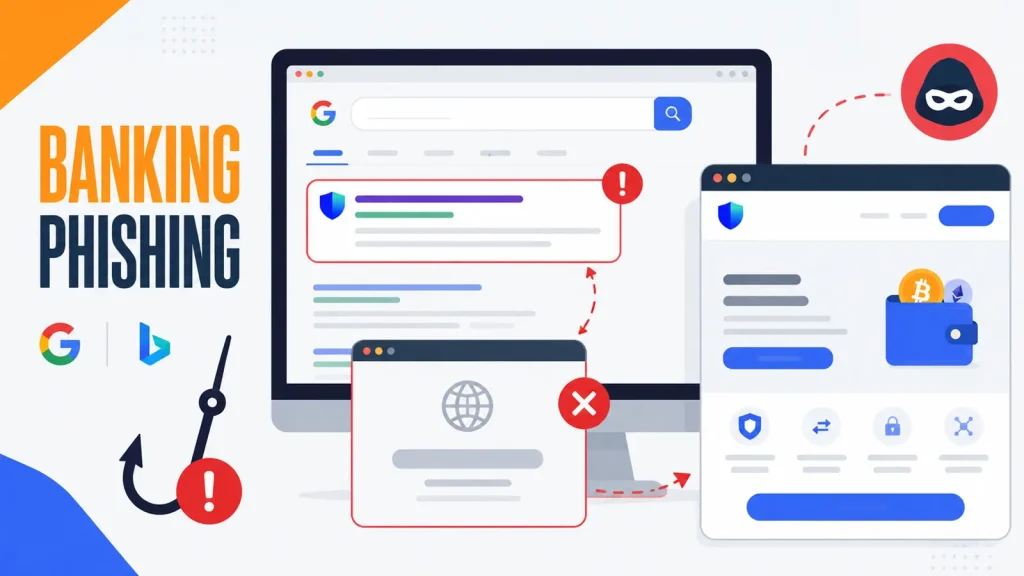
Hackers Poison Google and Bing Results to Deliver Cloaked Banking Phishing Pages
Imagine this: You need to access your online banking. You open your browser, type in your bank’s name, and click the first link that appears. Simple, right? Unfortunately, what you might encounter is not your bank’s legitimate login page, but a cleverly crafted trap designed to steal your credentials. This isn’t a hypothetical scenario; it’s a growing threat dubbed Chameleon SEO Poisoning, and it’s actively targeting Google and Bing search results, leading unsuspecting bank customers directly to sophisticated phishing pages.
The Devious Nature of Chameleon SEO Poisoning
Unlike traditional phishing attacks that rely on suspicious emails or text messages, Chameleon SEO Poisoning preys on trust in search engines. Cybercriminals manipulate search engine optimization (SEO) techniques to inject malicious, cloaked banking pages directly into prominent positions within Google and Bing search results. When a bank customer searches for common terms like “bank login” or their specific bank’s name, these fraudulent sites can appear alongside, or even above, legitimate banking portals. This tactic is particularly insidious because it leverages the inherent trust users place in search engine rankings.
How Cloaking Works to Deceive
The success of Chameleon SEO Poisoning hinges on a technique known as cloaking. Cloaking allows attackers to present different content to search engine crawlers than what they show to actual human users. When a search engine bot indexes the malicious page, it sees legitimate-looking content, perhaps even reflecting the actual bank’s information, which helps it rank higher. However, when a human user accesses the same URL, they are redirected to a carefully designed phishing page that mimics the bank’s genuine login portal. This deception makes it incredibly difficult for standard search engine algorithms to detect and filter out these malicious sites, as the initial content appears benign.
The Impact: A Direct Path to Credential Theft
The primary objective of these cloaked banking phishing pages is, unequivocally, credential theft. By luring users to fake login pages, attackers can capture usernames, passwords, and potentially other sensitive information such as multi-factor authentication codes. This stolen data can then be used to gain unauthorized access to bank accounts, conduct fraudulent transactions, or even facilitate identity theft. The direct route from a seemingly trustworthy search result to a phishing page significantly increases the likelihood of a successful attack, as victims are less likely to be on high alert for the typical red flags associated with email-based phishing.
Remediation Actions and Best Practices for Users and Organizations
Combating Chameleon SEO Poisoning requires a multi-layered approach, involving both user vigilance and proactive organizational measures.
- Verify URLs Always: Before entering any credentials, carefully examine the URL in your browser’s address bar. Look for HTTPS, a padlock icon, and ensure the domain name is the legitimate bank address. Be wary of subtle misspellings or extra characters.
- Bookmark Legitimate Sites: Instead of relying on search engines for every login, bookmark your bank’s official website and use that bookmark to access your account.
- Enable Multi-Factor Authentication (MFA): MFA adds an extra layer of security, making it significantly harder for attackers to access your accounts even if they steal your primary credentials.
- Report Suspicious Results: If you encounter a suspicious banking link in search results, report it to the respective search engine (Google, Bing, etc.) and your bank.
- Educate Employees and Customers: Organizations should continuously educate their employees and customers about SEO poisoning, cloaking, and how to identify phishing attempts.
- Implement DMARC, DKIM, and SPF: While primarily for email, these protocols help prevent domain spoofing, which can sometimes be part of a broader attack chain leading to credential theft.
Tools for Detection and Mitigation
While direct tools for detecting Chameleon SEO poisoning specifically within search results are limited due to its dynamic nature, several cybersecurity tools can aid in overall phishing detection and website security.
| Tool Name | Purpose | Link |
|---|---|---|
| PhishTank | Community-based phishing URL verification and reporting. | https://www.phishtank.com/ |
| Google Safe Browsing | API for checking URLs against Google’s list of unsafe web resources. | https://developers.google.com/safe-browsing |
| Web Application Firewalls (WAFs) | Protects web applications from various attacks, including some forms of content injection. | |
| Security Information and Event Management (SIEM) | Aggregates and analyzes security logs to detect anomalies and potential threats. |
The Evolving Landscape of Cyber Threats
Chameleon SEO Poisoning represents a sophisticated evolution in phishing tactics. It underscores the constant need for vigilance and adaptation in the face of increasingly clever cybercriminals. The days of easily identifiable phishing emails are gradually being supplemented by more intricate schemes that exploit fundamental aspects of our online behavior, such as using search engines. Staying informed and practicing robust cybersecurity hygiene are paramount to protecting personal and organizational assets in this dynamic threat landscape.
The information provided in this blog post is for educational purposes only and should not be construed as legal or professional advice. Always consult with a qualified cybersecurity expert for specific security concerns.




