
Hackers Turn Telegram Into a Command Center for HEAVYGRAM Surveillance Malware
HEAVYGRAM: How Attackers Are Weaponizing Telegram for Covert Surveillance
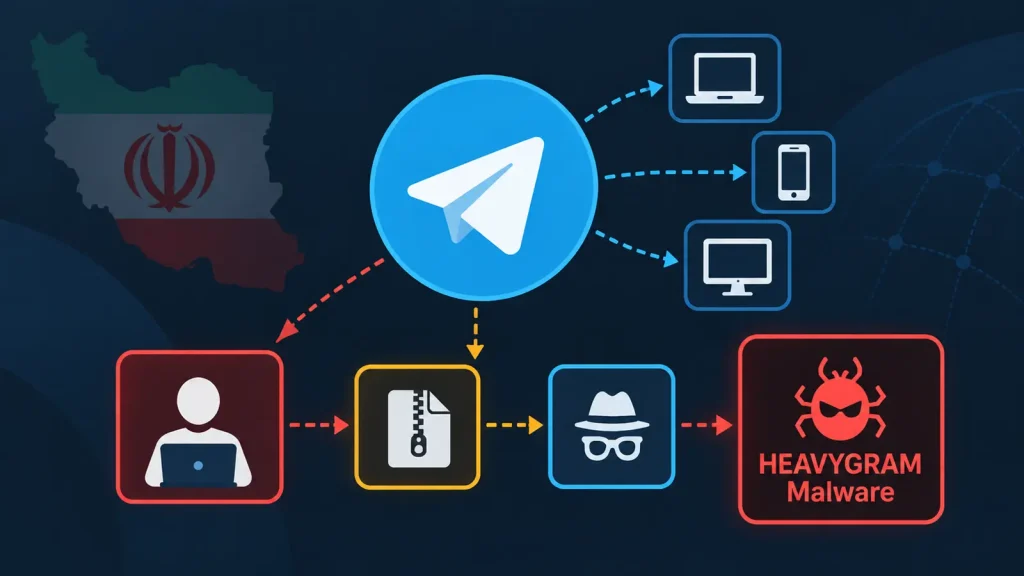
The digital battlefield is constantly shifting, with threat actors continuously innovating their methodologies. A recent, concerning development is the emergence of HEAVYGRAM, a sophisticated Windows surveillance backdoor that cleverly re-purposes the popular messaging application, Telegram, as its operational command center. This innovative approach allows attackers to maintain stealth, control infected devices, and exfiltrate sensitive data without the need for traditional, easily detectable command-and-control (C2) infrastructure.
First observed in late 2023, HEAVYGRAM has been actively deployed against high-value targets, including journalists, Iranian dissidents, and other individuals deemed strategically important by the attackers. Understanding its mechanics and implementing robust defensive strategies are paramount for anyone operating in sensitive environments.
Understanding HEAVYGRAM’s Modus Operandi
Unlike conventional malware that often relies on dedicated servers for command and control, HEAVYGRAM leverages Telegram’s inherent communication capabilities. This strategy offers several advantages to attackers:
- Decentralized C2: By using Telegram bots, accounts, and groups, HEAVYGRAM circumvents the need for a single, easily identifiable C2 server. This makes detection and takedown efforts significantly more challenging for cybersecurity professionals.
- Evasive Communication: Telegram’s end-to-end encryption and widespread legitimate use provide a covert channel for attackers to send instructions to infected machines and receive stolen data. The malicious traffic blends in with legitimate Telegram communications, making it harder to distinguish.
- Agile Control: Attackers can issue commands in real-time, adapting to the victim’s activities and extracting specific information as needed. This real-time interaction significantly enhances the effectiveness of the surveillance operation.
The malware operates as a Windows surveillance backdoor, implying a broad range of data exfiltration capabilities. While specific details on its full feature set are still emerging, typical surveillance backdoors can:
- Capture screenshots and keylogs.
- Record audio and video from compromised devices.
- Access and exfiltrate files, documents, and browsing history.
- Steal credentials and sensitive personal information.
Targeted Attacks and Their Implications
The fact that HEAVYGRAM has been primarily used against journalists and Iranian dissidents since its emergence in fall 2023 highlights a clear objective: intelligence gathering and suppression of dissent. This makes HEAVYGRAM a tool of state-sponsored actors or sophisticated criminal organizations with political motivations. The implications for individuals in these targeted groups are severe, potentially leading to:
- Loss of privacy and personal data.
- Compromise of journalistic sources and sensitive information.
- Increased risk of harassment, detention, or other forms of oppression.
The absence of a specific CVE number for HEAVYGRAM indicates it’s a new and evolving threat, likely exploiting common system vulnerabilities or relying on social engineering tactics for initial compromise rather than a single, disclosed software flaw.
Remediation Actions and Protective Measures
Defending against advanced persistent threats like HEAVYGRAM requires a multi-layered security approach. IT professionals and individuals, especially those in high-risk groups, should prioritize the following:
- Endpoint Detection and Response (EDR): Implement robust EDR solutions that can detect anomalous process behavior, network connections, and file system modifications, even if traffic appears to be legitimate.
- Network Traffic Analysis: Employ advanced network monitoring tools capable of deep packet inspection to identify unusual Telegram API calls or data exfiltration patterns, even within encrypted traffic.
- User Awareness Training: Educate users, particularly those in high-risk categories, on the dangers of phishing, social engineering, and downloading unverified software. Initial compromise often relies on these tactics.
- Principle of Least Privilege: Restrict user permissions to the absolute minimum necessary for their job functions. This limits the potential damage an attacker can inflict even if a system is compromised.
- Software Updates and Patching: Regularly update operating systems, applications, and security software to patch known vulnerabilities. While HEAVYGRAM may not exploit a specific CVE, a secure baseline reduces the attack surface.
- Regular Backups: Maintain regular, secure backups of critical data to enable recovery in the event of a successful attack.
- Multi-Factor Authentication (MFA): Implement MFA for all online accounts, especially for sensitive platforms, to prevent unauthorized access even if credentials are stolen.
Recommended Security Tools
| Tool Name | Purpose | Link |
|---|---|---|
| Osquery | Endpoint visibility and behavioral monitoring for detecting suspicious activities. | https://osquery.io/ |
| Snort | Network intrusion detection system for analyzing network traffic and identifying malicious patterns. | https://www.snort.org/ |
| Microsoft Defender for Endpoint | Comprehensive EDR solution for Windows environments with advanced threat protection. | https://www.microsoft.com/en-us/security/business/threat-protection/microsoft-defender-for-endpoint |
| Wireshark | Network protocol analyzer for deep inspection of network packets. | https://www.wireshark.org/ |
Conclusion: Adapting to the Evolving Threat Landscape
The rise of HEAVYGRAM underscores a critical trend in cybersecurity: attackers are becoming increasingly resourceful in their choice of command and control channels. By transforming a legitimate messaging application like Telegram into a clandestine operational hub, threat actors significantly complicate detection and mitigation efforts. Organizations and individuals must prioritize robust endpoint security, proactive network monitoring, and continuous user education to counter these sophisticated and evolving threats. Staying informed about new malware variants and adapting security postures accordingly is no longer optional, but an absolute necessity.




