
Hackers Use Fake Student Resume to Secretly Install Malware on Researchers’ Computers
In a concerning development, cybersecurity researchers have identified a new campaign where malicious actors are leveraging highly deceptive tactics to compromise systems. This sophisticated attack vector employs a fake student resume as a lure, discreetly installing remote access malware on the computers of unsuspecting researchers. This underscores the persistent threat of social engineering combined with advanced technical execution.
The Deceptive Lure: A Fake Student Resume
The core of this attack hinges on a meticulously crafted social engineering ploy. Threat actors are distributing an archive file that masquerades as a graduate-school application, ostensibly from a recent Beijing graduate. Within this seemingly innocuous archive lies the real payload: a Windows executable. The brilliance of this tactic lies in its ability to exploit trust and curiosity, particularly within academic or research circles where reviewing resumes and applications is a common practice.
Operational Mechanics: How the Malware Infiltrates
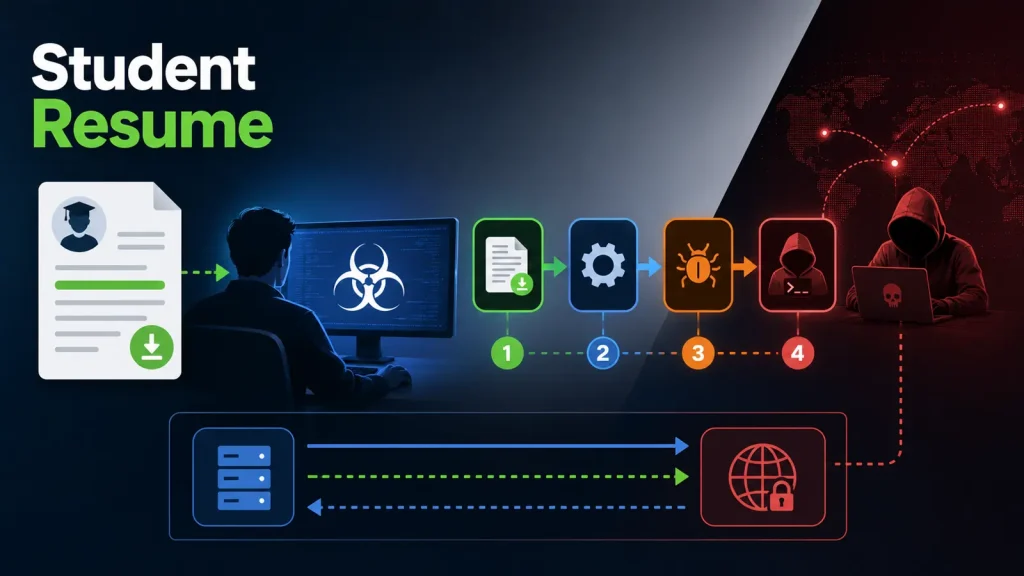
Upon execution, the malicious archive initiates a multi-stage infection process. The user is presented with a genuine Word document, creating a false sense of security and legitimacy. While the user is engrossed in reviewing the fabricated application, the hidden Windows executable silently installs a remote-access tool (RAT) in the background. This RAT grants the attackers persistent control over the compromised Windows computer, enabling them to exfiltrate data, monitor activities, or deploy further malicious payloads without detection.
- Initial Access: Phishing email or malicious download delivering the archive file.
- Execution Trigger: User opens the seemingly legitimate “graduate-school application” archive.
- Deception Layer: A genuine Word document opens to distract the victim.
- Payload Delivery: A hidden Windows executable silently installs the remote access tool (RAT).
- Persistent Control: The RAT establishes a backdoor for ongoing attacker access.
The Target: Researchers and Sensitive Data
The targeting of researchers is particularly alarming. Academic and research institutions often handle sensitive intellectual property, classified information, and cutting-edge discoveries. Compromising a researcher’s machine can lead to significant data breaches, intellectual property theft, and even national security implications. The choice of a “student resume” as a lure is effective because researchers frequently interact with aspiring academics and collaborate with individuals from various institutions.
Remediation Actions and Protective Measures
Protecting against such sophisticated attacks requires a multi-layered approach, combining robust technical controls with continuous user education. Organizations must prioritize vigilance and implement stringent security protocols.
- User Education: Conduct regular training on social engineering tactics, emphasizing the dangers of opening unsolicited attachments, even if they appear legitimate. Teach users to scrutinize sender addresses and email content for anomalies.
- Email Security Gateways: Implement advanced email security solutions capable of detecting and blocking malicious attachments, suspicious links, and phishing attempts.
- Endpoint Detection and Response (EDR): Deploy EDR solutions to monitor endpoints for suspicious activities, unauthorized process execution, and anomalous network connections. EDR can help detect the silent installation of RATs.
- Antivirus/Anti-Malware Software: Ensure all systems are running up-to-date antivirus and anti-malware software with real-time protection enabled.
- Principle of Least Privilege: Enforce the principle of least privilege, ensuring users and applications only have the necessary permissions to perform their tasks.
- Application Whitelisting: Consider implementing application whitelisting to prevent unauthorized executables from running on endpoints.
- Regular Backups: Maintain regular, secure, and offline backups of critical data to facilitate recovery in the event of a successful attack.
- Network Segmentation: Segment networks to limit the lateral movement of attackers if a system is compromised.
Tools for Detection and Analysis
Several tools can aid in the detection, analysis, and mitigation of threats like the one described. Utilizing a combination of these can significantly enhance an organization’s security posture.
| Tool Name | Purpose | Link |
|---|---|---|
| VirusTotal | Analyzes suspicious files and URLs for malware. | https://www.virustotal.com/ |
| Wireshark | Network protocol analyzer for investigating suspicious network traffic. | https://www.wireshark.org/ |
| Procmon (Process Monitor) | Advanced monitoring tool for Windows that shows real-time file system, Registry, and process/thread activity. | https://learn.microsoft.com/en-us/sysinternals/downloads/procmon |
| Cuckoo Sandbox | Automated malware analysis system. | https://cuckoosandbox.org/ |
| Sysmon (System Monitor) | Windows system service and device driver that monitors and logs system activity to the Windows event log. | https://learn.microsoft.com/en-us/sysinternals/downloads/sysmon |
Conclusion
The use of a fake student resume to deploy remote access malware highlights the evolving sophistication of social engineering attacks. This incident serves as a critical reminder that even seemingly innocuous documents can harbor significant threats. Organizations, particularly those in research and academia, must fortify their defenses through robust technical controls, continuous security awareness training, and proactive threat intelligence. Vigilance remains the strongest shield against such insidious tactics.




