
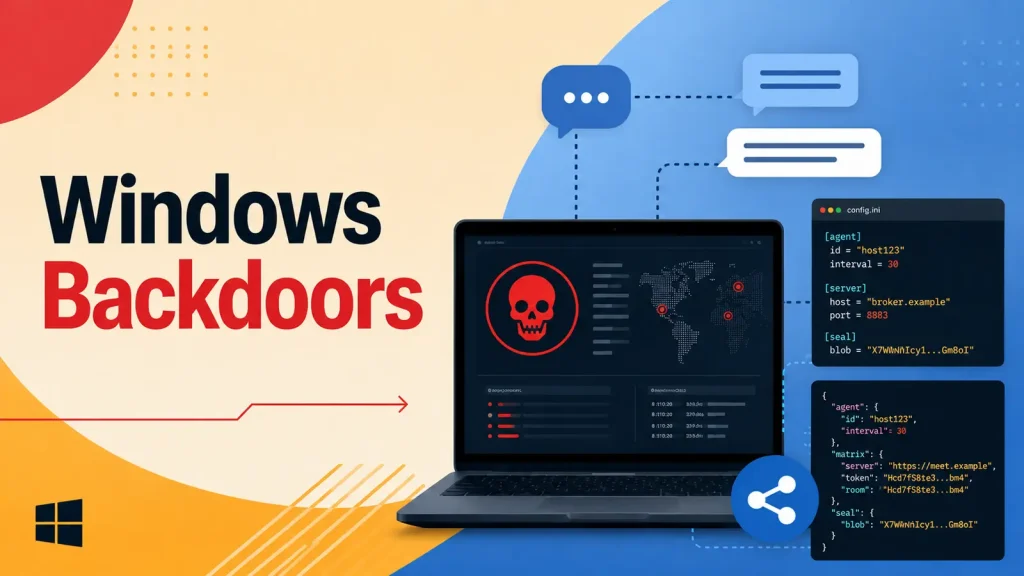
Hackers Use Popular Messaging Services to Control New Windows Backdoors
In the relentlessly evolving landscape of cyber threats, financially motivated groups continually seek innovative methods to bypass defenses and maintain persistence. A recent campaign by the group known as Toy Ghouls highlights this trend, revealing their adoption of two novel Windows backdoors. These custom tools leverage popular messaging and broker services for command and control (C2) communication, presenting a discreet and effective mechanism for attackers to operate within compromised environments.
This strategic shift marks a significant development for Toy Ghouls, indicating an adaptation in their operational tactics. Previously, such groups might have relied on more traditional C2 channels. The integration of widely used messaging platforms, however, offers a low-profile conduit for exfiltrating sensitive data, executing commands, and maintaining stealthy control over infected systems.
Understanding the Toy Ghouls’ New Modus Operandi
The Toy Ghouls threat group, known for its financially motivated campaigns, has recently escalated its capabilities by deploying two distinct custom Windows backdoors. These backdoors are engineered for stealth and persistence, enabling attackers to perform critical functions such as collecting system information, executing arbitrary commands, and maintaining a foothold on compromised devices.
What makes this campaign particularly noteworthy is the group’s pivot towards leveraging legitimate messaging and broker services for their C2 infrastructure. This method inherently blends malicious traffic with legitimate network activity, making detection significantly more challenging for conventional security tools that might flag unusual protocols or direct IP connections.
The Technical Evolution of Custom Backdoors
The custom Windows backdoors employed by Toy Ghouls are sophisticated. While specific technical details regarding their naming conventions or unique identifiers (like a CVE for the backdoor itself, which isn’t applicable in this context as it’s a tool, not a vulnerability) are not publicly available from the source, their functionality points to a well-engineered design. These backdoors are designed to:
- Gather System Intelligence: Collect detailed information about the compromised host, including operating system versions, installed software, network configurations, and user credentials.
- Execute Remote Commands: Allow the attackers to run arbitrary commands on the victim’s machine, facilitating further exploitation, lateral movement, or data exfiltration.
- Maintain Persistence: Employ various mechanisms to ensure their continued operation even after system reboots, often by modifying registry keys or establishing scheduled tasks.
The critical innovation lies in their communication method. By using popular messaging and broker services, the C2 traffic mimics legitimate user activity, significantly reducing the likelihood of detection by traditional network intrusion detection systems (NIDS) or firewalls.
Remediation Actions and Proactive Defenses
Defending against advanced persistent threats like those posed by Toy Ghouls requires a multi-layered security strategy. Given their use of messaging services for C2, a focus on endpoint detection and response (EDR), robust network monitoring, and user awareness is paramount.
Endpoint Security Enhancements
- Advanced EDR Solutions: Deploy and maintain EDR solutions capable of behavioral analysis. These tools can detect suspicious process activity, unauthorized script execution, and unusual file modifications that might indicate backdoor presence, even if C2 traffic is disguised.
- Application Whitelisting: Implement strict application whitelisting policies to prevent the execution of unauthorized executables and scripts. This can significantly mitigate the impact of custom backdoors.
- Regular Patch Management: Ensure all operating systems, applications, and security software are consistently updated to patch known vulnerabilities. While this specific campaign doesn’t leverage a single CVE, good hygiene prevents initial compromise.
Network Monitoring and Traffic Analysis
- Deep Packet Inspection (DPI): While traditional firewalls might struggle, DPI capabilities in next-generation firewalls (NGFW) or dedicated security appliances can sometimes identify anomalous patterns within encrypted messaging traffic, even if the protocol is legitimate.
- Proxy Server Monitoring: Implement and meticulously monitor proxy server logs. Suspicious connections to messaging service APIs that originate from automated processes or non-browser applications can be indicators of compromise.
- Behavioral Analytics: Utilize network behavioral analytics (NBA) tools to establish baselines of normal network traffic. Deviations from these baselines, even within seemingly legitimate traffic types, can signal malicious activity.
User Education and Awareness
- Phishing Awareness Training: As initial access often occurs via phishing or social engineering, regular and effective training for all employees is crucial to prevent the initial compromise.
- Principle of Least Privilege: Enforce the principle of least privilege for all user accounts and applications, limiting the damage an attacker can inflict if a system is compromised.
There is no single CVE linked to these custom backdoors as they are newly developed tools, not publicly disclosed vulnerabilities in existing software. The threat lies in their deployment and C2 methodology.
Tools for Detection and Mitigation
Implementing a robust security posture against sophisticated threats requires leveraging a variety of security tools. The following table outlines relevant tools that can aid in detecting and mitigating the risks posed by campaigns like Toy Ghouls:
| Tool Name | Purpose | Link |
|---|---|---|
| Microsoft Defender for Endpoint | Advanced EDR, behavioral analysis, threat intelligence integration. | https://www.microsoft.com/en-us/security/business/threat-protection/microsoft-defender-for-endpoint |
| CrowdStrike Falcon Insight | Cloud-native EDR, threat hunting, vulnerability management. | https://www.crowdstrike.com/products/endpoint-security/falcon-insight-xdr/ |
| Splunk Enterprise Security | SIEM, behavioral analytics, threat detection, incident response. | https://www.splunk.com/en_us/software/splunk-enterprise-security.html |
| Palo Alto Networks Next-Generation Firewall | Network intrusion prevention, application visibility, deep packet inspection. | https://www.paloaltonetworks.com/network-security/next-generation-firewall |
| Open-source Proxies (e.g., Squid) | Web proxy for traffic monitoring and filtering. | http://www.squid-cache.org/ |
The Evolving Threat Landscape
The campaign by Toy Ghouls serves as a stark reminder that cyber adversaries are constantly refining their tactics. The shift to using popular messaging and broker services for C2 operations represents a significant challenge for traditional security perimeters. Organizations must adopt a proactive and adaptive security posture, focusing on advanced endpoint protection, comprehensive network visibility, and continuous security awareness training to counter these evolving threats effectively.
Understanding the adversary’s methods and adapting defense strategies accordingly is not merely a best practice; it is a fundamental requirement for maintaining security in today’s interconnected world.




