
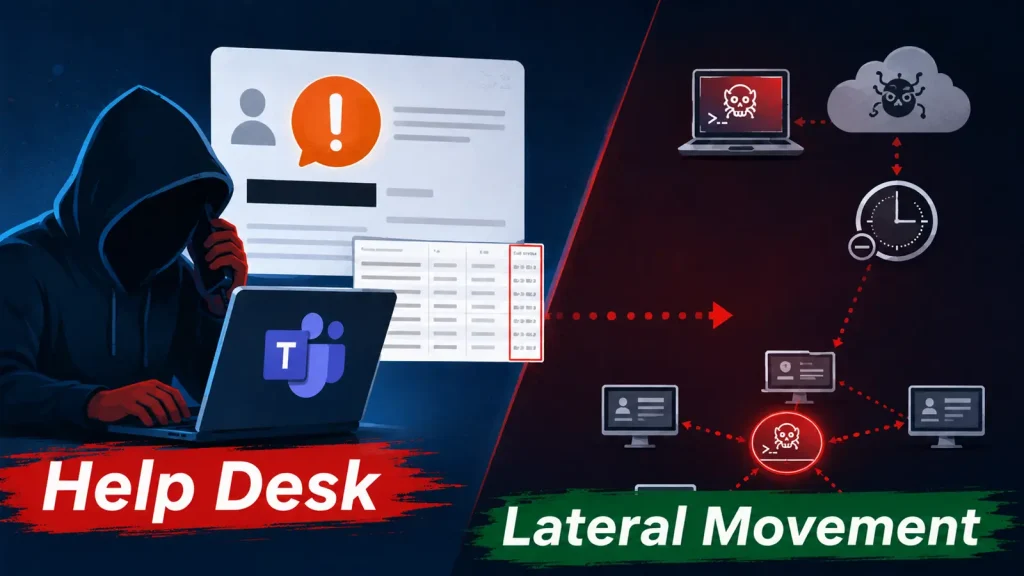
Hackers Weaponize Microsoft Teams Help Desk Calls for Malware and Network Lateral Movement
The Deceptive Call: How Hackers Weaponize Microsoft Teams Help Desk Impersonations
In a world increasingly reliant on collaborative platforms, the very tools designed for efficiency can become potent weapons in the hands of cyber attackers. Recent intelligence reveals a sophisticated campaign where threat actors are leveraging Microsoft Teams help desk calls as a primary vector for malware delivery and lateral network movement. This isn’t just about phishing emails anymore; it’s about weaponizing trust and familiar communication channels to gain a foothold within organizations.
Spring Ring: A New Era of Impersonation Attacks
A campaign dubbed “Spring Ring” highlights this alarming trend. From January through April 2026, attackers meticulously crafted a scheme that began with external accounts masquerading as internal IT support staff. These fake profiles initiated chats with unsuspecting employees, building a rapport before escalating to a voice call. The ultimate objective was to pressure targets into granting remote access or executing malicious software, effectively bypassing traditional perimeter defenses.
This tactic demonstrates a deep understanding of human psychology and organizational workflows. Employees, accustomed to receiving legitimate support requests through Teams, are less likely to question a message from what appears to be their internal IT department. The subsequent voice call adds a layer of social engineering, making the interaction feel more authentic and urgent, thereby increasing the likelihood of compliance.
The Mechanics of Compromise: From Chat to Control
The attackers’ methodology is alarmingly effective. It typically follows a multi-stage approach:
- Initial Contact: Malicious external accounts, often using names and profile pictures designed to mimic legitimate IT personnel, initiate chats with employees. These messages often feign a technical issue or require “urgent” attention.
- Building Trust: Through conversational exchanges, the attackers aim to establish a sense of legitimacy and urgency. They might refer to common IT problems or company-specific software to appear credible.
- Escalation to Call: Once trust is established, or the urgency is heightened, the attacker transitions to a voice call within Teams. This personal interaction makes it harder for the victim to disbelieve the caller’s identity.
- Pressuring for Access/Execution: During the call, the attacker guides the victim to perform actions that compromise their system. This could involve installing remote access software, executing a seemingly legitimate update, or clicking a malicious link disguised as a support portal.
- Malware Delivery & Lateral Movement: Once access is gained or malware is executed, the attackers can deploy a range of payloads, from ransomware to information stealers. They then leverage this initial foothold for lateral movement across the network, seeking higher-privileged accounts and sensitive data.
Remediation Actions and Proactive Defenses
Defending against such sophisticated social engineering attacks requires a multi-layered approach that combines technological controls with robust employee training.
- Enhanced Employee Training: Conduct regular, realistic phishing and social engineering simulations specifically targeting Teams communications. Train employees to verify the identity of IT support personnel through out-of-band channels (e.g., calling a known IT help desk number directly) before granting any access or executing software.
- Strict External Communication Policies: Implement and enforce policies regarding external users communicating with internal employees via Teams. Consider restricting external invitations or requiring explicit approval for new external contacts.
- Multi-Factor Authentication (MFA) Everywhere: Ensure MFA is enforced for all Microsoft Teams accounts and any systems that can be accessed remotely. This significantly reduces the impact of compromised credentials.
- Endpoint Detection and Response (EDR): Deploy and configure EDR solutions to monitor endpoints for suspicious activity, including the execution of unknown applications, unauthorized remote access tools, or unusual network connections.
- Network Segmentation: Implement strong network segmentation to limit the ability of attackers to move laterally once an initial compromise occurs.
- Least Privilege Principle: Ensure users only have the necessary permissions to perform their job functions. This minimizes the damage if an account is compromised.
- Security Awareness Campaigns: Regularly remind employees about the risks of unsolicited requests, especially those asking for remote access or software installation, even if they appear to come from internal IT.
Tools for Detection and Mitigation
Leveraging the right tools can significantly enhance your organization’s ability to detect and mitigate these types of attacks.
| Tool Name | Purpose | Link |
|---|---|---|
| Microsoft Defender for Endpoint | Endpoint detection and response, behavioral analysis. | Microsoft Link |
| Security Information and Event Management (SIEM) | Aggregating and analyzing logs from various sources for suspicious activity. | (Vendor Specific) |
| Cloud Access Security Broker (CASB) | Monitoring and securing cloud application usage, including Microsoft Teams. | (Vendor Specific) |
| User and Entity Behavior Analytics (UEBA) | Detecting anomalous user behavior indicative of compromise. | (Vendor Specific) |
Staying Ahead of the Curve
The Spring Ring campaign underscores a critical shift in cyberattack methodologies. Threat actors are increasingly focusing on social engineering and exploiting trusted communication platforms like Microsoft Teams. As cybersecurity professionals, our role extends beyond perimeter defense; it involves cultivating a security-aware culture where every employee understands their role in protecting the organization. By implementing robust technical controls and fostering continuous security education, we can significantly reduce the attack surface and fortify our defenses against these evolving threats.




