
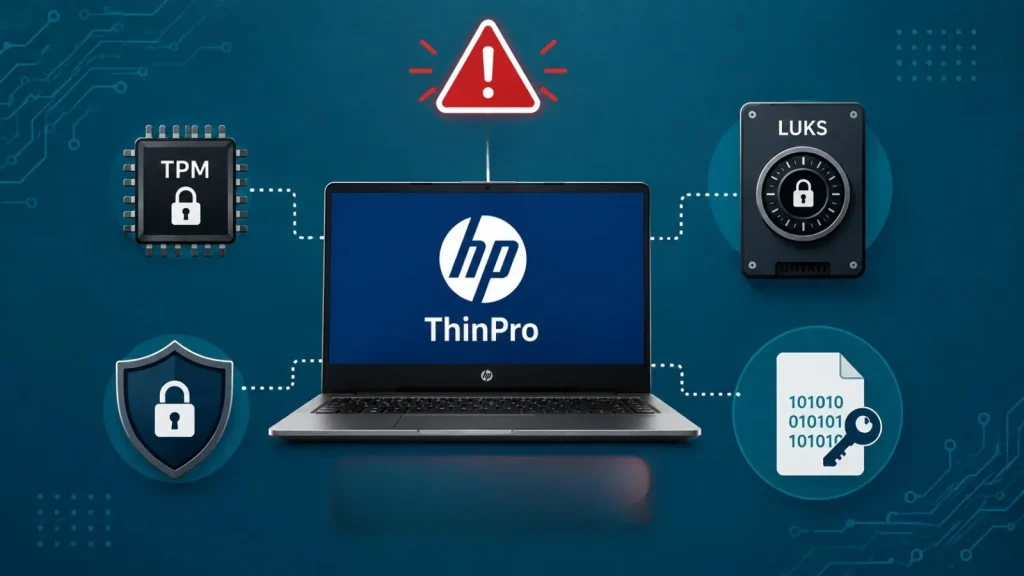
HP ThinPro TPM Disk Encryption Flaw Lets Attackers Extract LUKS Keys
In the evolving landscape of enterprise security, the integrity of endpoint devices is paramount. When foundational security mechanisms are compromised, the ripple effects can be severe, exposing sensitive data and critical infrastructure. A recent disclosure has brought to light a significant boot-chain weakness impacting HP ThinPro operating systems, specifically concerning their TPM-backed disk encryption. This vulnerability, which allows for the extraction of LUKS keys with physical access, presents a tangible threat to organizations relying on these thin clients.
Understanding the HP ThinPro TPM Disk Encryption Flaw
A security researcher has identified a critical flaw within HP ThinPro 8 and 9 operating systems that directly impacts the security of encrypted data. The core of the issue lies in a boot-chain weakness that, under specific conditions, permits an attacker with physical access to an HP thin client to extract its Linux Unified Key Setup (LUKS) disk-encryption key. This is particularly concerning because LUKS is widely used to protect the operating system’s encrypted root partition, with the decryption key typically sealed within the Trusted Platform Module (TPM) for enhanced security.
The vulnerability primarily affects HP thin clients where LUKS2 is employed for disk encryption. The purpose of sealing the decryption key within the TPM is to bind it to the specific hardware configuration, making it incredibly difficult to retrieve without the correct boot sequence and hardware integrity checks. However, this newly discovered weakness circumvents these protections, undermining the very foundation of TPM-backed full disk encryption on these devices.
Technical Breakdown: How LUKS Keys Can Be Extracted
The mechanism behind this exploit leverages a flaw in the boot process of HP ThinPro. While specific technical details of the researcher’s methodology are proprietary, the general principle involves manipulating the boot chain to bypass the integrity checks that normally protect the LUKS key. Once physical access is gained, an attacker can interfere with the boot process before the TPM fully releases or verifies the LUKS key against the system’s state. This allows for the interception or extraction of the key, rendering the disk encryption ineffective.
The use of LUKS2, while generally more robust than its predecessor, does not mitigate this particular boot-chain weakness when the TPM sealing process is compromised. This highlights that even advanced encryption schemes can be undermined if the underlying implementation and boot security are not meticulously hardened.
Affected Systems and CVE Identifiers
This vulnerability specifically impacts HP ThinPro 8 and 9. Organizations utilizing HP thin clients running these operating system versions should consider their devices at risk if physical security cannot be absolutely guaranteed. The official Common Vulnerabilities and Exposures (CVE) identifier for this flaw is CVE-2023-42171. This identifier helps in tracking and referencing the vulnerability across security advisories and patching efforts.
Remediation Actions
Addressing a boot-chain vulnerability with physical access implications requires a multi-faceted approach. Organizations should take immediate steps to mitigate potential risks:
- Apply Vendor Patches: HP has released patches to address CVE-2023-42171. All affected HP ThinPro 8 and 9 devices must be updated to the latest firmware and operating system versions as recommended by HP.
- Enhance Physical Security: Given that this exploit requires physical access, strengthening physical security measures for all thin clients is crucial. This includes secure locations, locked enclosures, and strict access controls to reduce the window of opportunity for an attacker.
- Implement Secure Boot: Ensure that Secure Boot is enabled and properly configured on all thin clients. Secure Boot helps to prevent unauthorized software from loading during the boot process, thereby protecting the integrity of the boot chain.
- Regular Security Audits: Conduct regular audits of thin client configurations and security policies to ensure compliance and identify any potential weaknesses.
- Employee Awareness Training: Educate employees on the importance of physical security for their devices and reporting any suspicious activities or unauthorized access attempts.
Detection and Mitigation Tools
While direct detection of a boot-chain manipulation attempt in progress can be challenging, several tools and practices can aid in monitoring system integrity and applying mitigation:
| Tool Name | Purpose | Link |
|---|---|---|
| HP Support Assistant | Manages HP updates and drivers, crucial for applying security patches. | https://www8.hp.com/us/en/campaigns/hpsupportassistant/hpsupport.html |
| Endpoint Detection and Response (EDR) Solutions | Monitors endpoint activities for suspicious behavior, though boot-chain attacks may occur pre-OS load. | Varies by vendor (e.g., CrowdStrike, SentinelOne) |
| Disk Encryption Management Tools | Verifies LUKS integrity and encryption status. | Built-in Linux utilities (e.g., cryptsetup) |
| Physical Security Devices | Locks, alarms, and surveillance systems to prevent unauthorized physical access. | Varies by vendor |
Key Takeaways
The HP ThinPro TPM disk encryption flaw underscores a critical lesson in cybersecurity: even robust encryption technologies like LUKS, when combined with hardware security features like TPM, can be vulnerable if the underlying boot process is not perfectly secured. Organizations must prioritize applying vendor patches, reinforcing physical security measures, and ensuring that all layers of their endpoint security are consistently maintained and audited. Ignoring such fundamental weaknesses can expose sensitive data and significantly increase an organization’s attack surface.




