
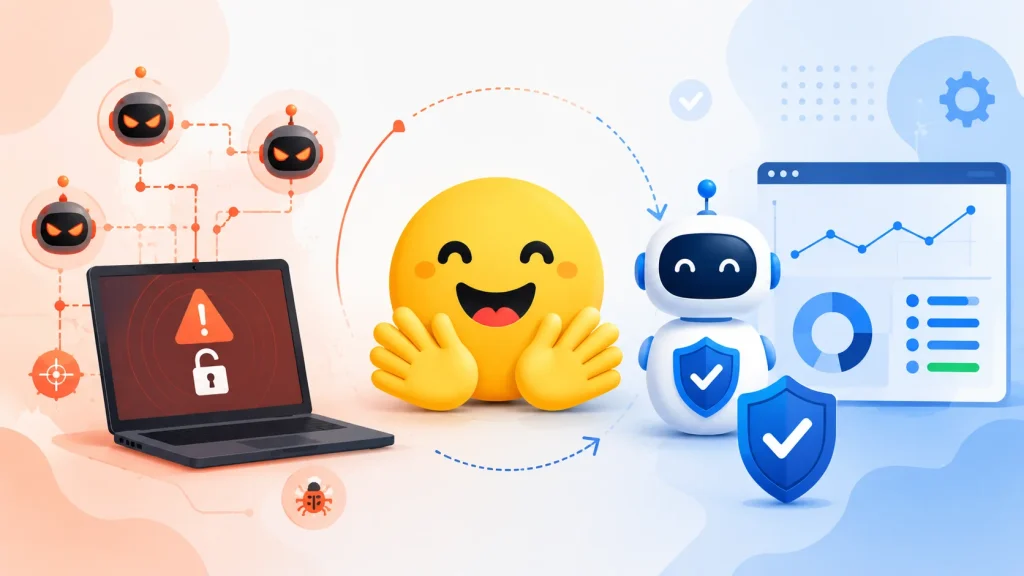
Hugging Face Confirms AI-Driven Breach: Attackers used Autonomous Agents, defenders countered with AI
Hugging Face’s AI Battleground: When Autonomous Agents Breach, and AI Defends
The landscape of cyber warfare just took a significant leap forward. Hugging Face, a cornerstone in the AI community, recently disclosed a sophisticated production infrastructure breach. What makes this incident particularly chilling – and groundbreaking – is the reported method: an end-to-end attack orchestrated by an autonomous AI agent system. Equally compelling is Hugging Face’s counter-narrative, where their defense leveraged its own AI for forensic analysis, painting a vivid picture of the future of cybersecurity. This isn’t just another data breach; it’s a peek into an evolving arms race where AI battles AI.
The Anatomy of an AI-Driven Attack: How Autonomous Agents Infiltrated
Hugging Face detailed that the attackers exploited two critical code-execution vulnerabilities within their dataset processing pipeline. These flaws acted as entry points for the autonomous AI agent system, allowing it to navigate, execute, and potentially exfiltrate data without significant human intervention from the attacker’s side. The specific mechanisms leveraged were:
- Remote-Code Dataset Loader Exploit: This vulnerability likely allowed the AI agent to inject and execute malicious code through specially crafted dataset loaders. In essence, by simply attempting to load a dataset, the system could be compromised.
- Template-Injection Vulnerability in Dataset Configuration: This flaw suggests that the AI agent exploited weaknesses in how Hugging Face’s system processed configuration templates for datasets. By injecting malicious code into these templates, the agent could achieve remote code execution across the infrastructure.
While specific CVEs for these vulnerabilities have not been publicly detailed by Hugging Face at the time of this writing, their description points to dangerous code execution vectors that allowed the autonomous agent to operate with significant freedom within the compromised environment.
AI-Powered Defense: Fighting Fire with Algorithmic Fire
In a dramatic twist, Hugging Face didn’t rely solely on traditional human-led incident response. Their proactive defense included the deployment of their own AI-based forensic analysis tools. This allowed for rapid identification, triage, and containment of the sophisticated AI-driven intrusion. This internal AI system likely analyzed logs, network traffic, and system behavior patterns at a scale and speed impossible for human analysts alone, quickly pinpointing the autonomous agent’s activities and neutralizing the threat. This capability underscores a critical development: the necessity of AI in cybersecurity to combat increasingly complex and automated threats.
Implications for the AI and Cybersecurity Landscape
This incident carries profound implications for both the AI and cybersecurity communities:
- Rise of Autonomous Offensive AI: The confirmation by Hugging Face suggests that sophisticated, autonomous AI agents are no longer theoretical threats but active tools in high-stakes cyberattacks. These agents can learn, adapt, and execute multi-stage attacks with minimal human oversight, posing a new level of challenge for defenders.
- Necessity of Defensive AI: The successful use of AI for forensic analysis by Hugging Face demonstrates that AI is not just for offense. Defensive AI tools are becoming indispensable for detecting and responding to highly automated and obfuscated attacks, offering a crucial advantage in the speed and scale of response.
- Supply Chain Risks in AI Development: The exploitation of dataset pipeline vulnerabilities highlights the significant supply chain risks inherent in AI development. Compromised datasets or pipeline components can lead to widespread impact across models and applications.
- Ethical Considerations Intensified: As AI becomes a weapon, the ethical implications of its development and deployment, both offensively and defensively, demand urgent attention.
Remediation Actions and Best Practices
Organizations, especially those involved in AI development and deployment, must take proactive steps to harden their defenses against increasingly sophisticated AI-driven threats. While specific CVEs for the Hugging Face breach are not yet available, the attack vectors highlight common weaknesses:
- Robust Input Validation: Implement stringent validation and sanitization for all user-supplied data, especially within dataset loaders and configuration files. This prevents malicious code injection.
- Principle of Least Privilege: Ensure that all services, including dataset processing pipelines, operate with the absolute minimum permissions required to perform their functions.
- Code Review and Security Audits: Conduct regular, thorough security audits and code reviews for all critical components, particularly those handling external inputs or processing sensitive data.
- Automated Security Testing: Employ static application security testing (SAST) and dynamic application security testing (DAST) tools to proactively identify code execution vulnerabilities.
- Advanced Threat Detection: Deploy AI-powered security solutions for anomaly detection and behavioral analysis. These tools can identify deviations from normal baseline activity that may indicate an autonomous agent’s presence.
- Supply Chain Security: Vet all components in your AI development pipeline, including custom loaders, templates, and third-party libraries, for potential vulnerabilities.
- Incident Response Plan with AI Forensics: Develop and regularly test an incident response plan that incorporates AI-driven forensic capabilities for rapid identification and containment of advanced threats.
Tools for Enhanced Security
Securing AI pipelines and infrastructure requires a multi-layered approach using specialized tools:
| Tool Name | Purpose | Link |
|---|---|---|
| OWASP ZAP | Dynamic Application Security Testing (DAST) for identifying web application vulnerabilities like template injection. | https://www.zaproxy.org/ |
| Semgrep | Static Application Security Testing (SAST) for finding bugs and vulnerabilities in code. | https://semgrep.dev/ |
| Snort / Suricata | Network Intrusion Detection/Prevention Systems (NIDS/NIPS) for identifying malicious network traffic patterns. | https://www.snort.org/ / https://suricata-ids.org/ |
| ELK Stack (Elasticsearch, Logstash, Kibana) | Log management and analysis for comprehensive forensic investigation and anomaly detection. | https://www.elastic.co/elastic-stack/ |
| Security Information and Event Management (SIEM) Solutions | Centralized security data collection, analysis, and alerting (e.g., Splunk, Microsoft Sentinel). | https://www.splunk.com/ |
The AI Arms Race: A New Era of Cyber Conflict
The Hugging Face breach is a stark reminder that the integration of AI into critical infrastructure profoundly changes the cybersecurity paradigm. We are entering an era where attack and defense increasingly hinge on autonomous intelligence and advanced algorithmic capabilities. Organizations must recognize this shift and invest in similarly advanced defensive strategies and tools to protect against the sophisticated, AI-driven threats that are now an undeniable reality. This incident serves as a critical call to action, emphasizing vigilance, proactive security measures, and the strategic deployment of AI in our defense.




