
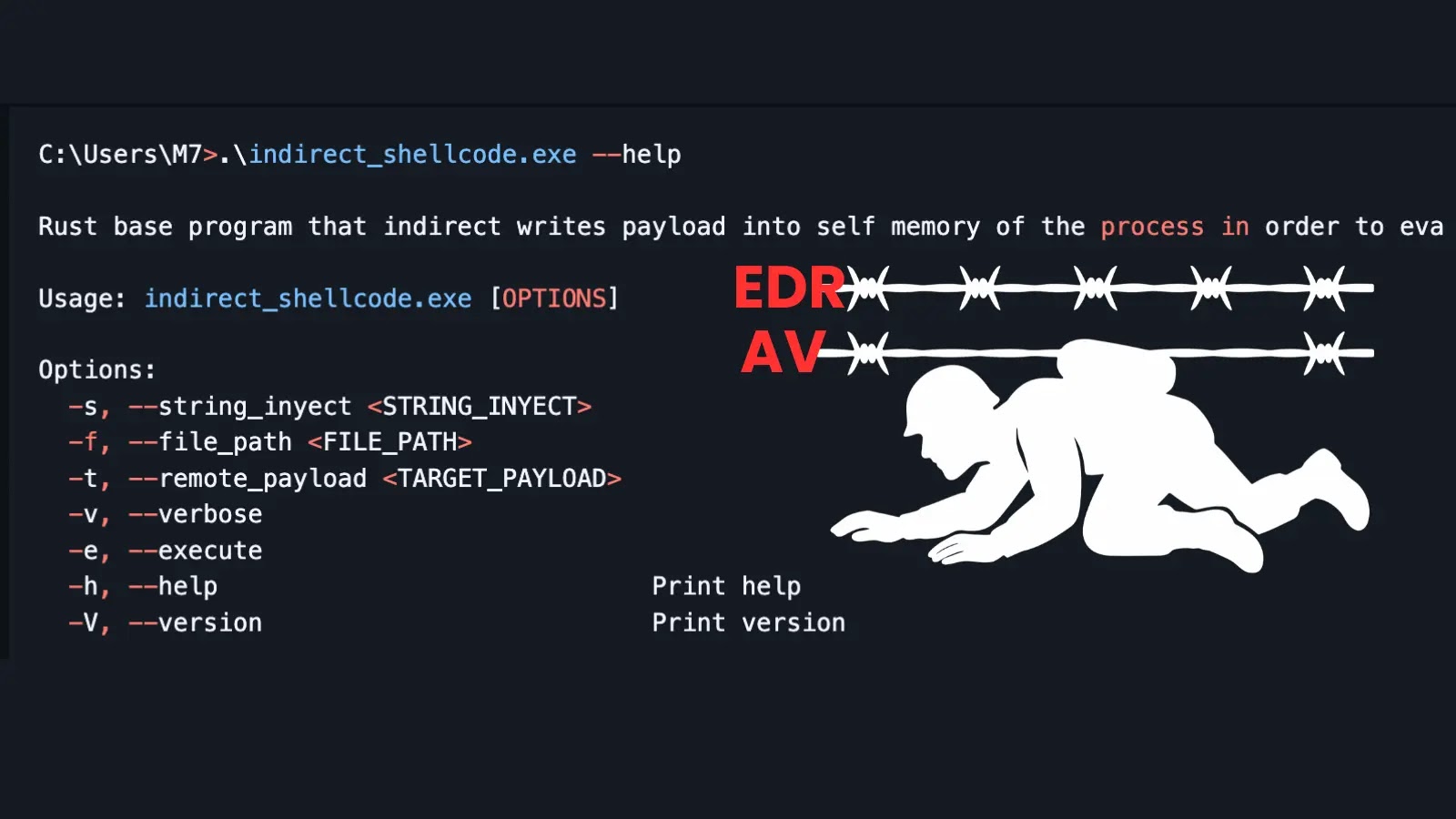
Indirect-Shellcode-Executor Tool Exploits Windows API Vulnerability to Evade AV and EDR
A disturbing new development in offensive security is challenging the effectiveness of modern Endpoint Detection and Response (EDR) and antivirus (AV) solutions. A novel tool, aptly named Indirect-Shellcode-Executor, written in Rust, leverages an often-overlooked behavior within the Windows API to bypass traditional security mechanisms. This innovative approach presents a significant threat, forcing security professionals to re-evaluate their defense strategies against sophisticated evasion techniques.
The Evolving Landscape of EDR Evasion
Endpoint security has steadily advanced, moving beyond signature-based detection to sophisticated behavioral analysis and machine learning. EDR systems are designed to monitor API calls, process injections, and suspicious activities to identify and neutralize threats. However, attackers continuously seek out new methods to circumvent these defenses. The Indirect-Shellcode-Executor represents a calculated move in this ongoing cat-and-mouse game, exploiting a blind spot in how security products typically monitor memory operations.
Understanding Indirect-Shellcode-Executor’s Evasion Technique
The core innovation behind Indirect-Shellcode-Executor lies in its judicious use of the ReadProcessMemory function, a legitimate Windows API call. Unlike more common shellcode injection methods that directly write to memory using functions like WriteProcessMemory or allocate executable memory with VirtualAllocEx followed by CreateRemoteThread, this tool采取a different path. By using ReadProcessMemory, the attacker effectively “reads” the shellcode into the target process’s memory in a way that often bypasses the hooks and monitoring established by EDR solutions for write operations or suspicious API sequence calls. This technique capitalizes on the assumption that reading memory is generally benign, thus making the initial injection less likely to trigger an alert.
Once the shellcode is loaded into memory via this indirect method, the tool then triggers its execution, potentially leading to arbitrary code execution, privilege escalation, or further malicious activity on the compromised system. This approach neatly sidesteps the typical API monitoring points that security vendors have meticulously developed to detect malicious process injection and execution.
Why This Technique Works: The Windows API Blind Spot
The success of Indirect-Shellcode-Executor highlights a subtle but critical vulnerability in how some security products interpret and monitor Windows API calls. EDRs often focus on detecting direct write operations to executable memory regions or sequences of API calls known to facilitate shellcode injection. The use of ReadProcessMemory for initial code introduction into a process’s address space is an unconventional technique. This makes it challenging for rule-based or even behavioral EDR engines to flag it as malicious without generating a significant number of false positives on legitimate applications that also use ReadProcessMemory for benign purposes.
This method doesn’t exploit a traditional CVE (Common Vulnerabilities and Exposures) in the Windows API itself, such as CVE-2023-21768 which concerns a Windows Advanced Local Procedure Call (ALPC) elevation of privilege vulnerability. Instead, it exploits a behavioral oversight in how security software monitors for malicious activity, leveraging a legitimate function in an illegitimate context. This nuanced attack vector necessitates a shift in defensive strategies.
Remediation Actions and Enhanced Detection Strategies
Defending against techniques like Indirect-Shellcode-Executor requires a multi-layered approach and an evolution in detection capabilities. Organizations must move beyond solely monitoring direct injection attempts and consider the broader context of process behavior.
- Enhanced Behavioral Analysis: EDR solutions need to improve their behavioral baselining to identify anomalous process interactions, even if individual API calls appear benign. This includes monitoring memory access patterns beyond just write operations.
- Memory Region Permissions Monitoring: Strictly monitor changes to memory region permissions. While
ReadProcessMemoryitself might not directly change permissions, the subsequent execution will often involve a memory region becoming executable. - Thread and Process Creation Anomalies: Strengthen detection for suspicious thread creation (e.g., from an unusual parent process or in an unexpected memory region) or unexpected process spawning as a follow-up action to shellcode execution.
- Threat Intelligence Integration: Stay updated with the latest offensive security techniques and integrate this intelligence into security tools. Vendors and internal security teams should proactively research and develop signatures or behavioral rules for new evasion methods.
- Application Whitelisting: Implement strict application whitelisting policies to prevent unauthorized executables, including custom-developed offensive tools, from running on endpoints.
- Regular Security Audits and Penetration Testing: Conduct regular assessments using red teaming and penetration testing that incorporate advanced evasion techniques to continuously evaluate and improve existing defenses.
Relevant Tools for Detection and Mitigation
| Tool Name | Purpose | Link |
|---|---|---|
| Sysmon | Advanced system activity monitoring and logging for anomaly detection. | Microsoft Sysinternals Sysmon |
| Procmon | Real-time file system, Registry, and process/thread activity monitoring. | Microsoft Sysinternals Procmon |
| Elastic Security (SIEM/EDR) | Comprehensive SIEM and EDR capabilities for threat detection and response. | Elastic Security |
| Osquery | Operating system instrumentation framework for exposing OS data as a high-performance relational database. | Osquery |
| CrowdStrike Falcon Insight | AI-powered EDR for sophisticated threat detection and hunting. | CrowdStrike Falcon Insight |
Conclusion
The emergence of tools like Indirect-Shellcode-Executor underscores the dynamic and challenging nature of cybersecurity. Attackers are constantly innovating, finding subtle ways to leverage legitimate system functionalities for malicious ends. Security professionals must remain vigilant, understanding not just the “what” but the “how” behind these novel evasion techniques. By continuously evolving detection strategies to focus on behavioral anomalies and integrated threat intelligence, organizations can build more resilient defenses against these advanced, stealthy threats.




