
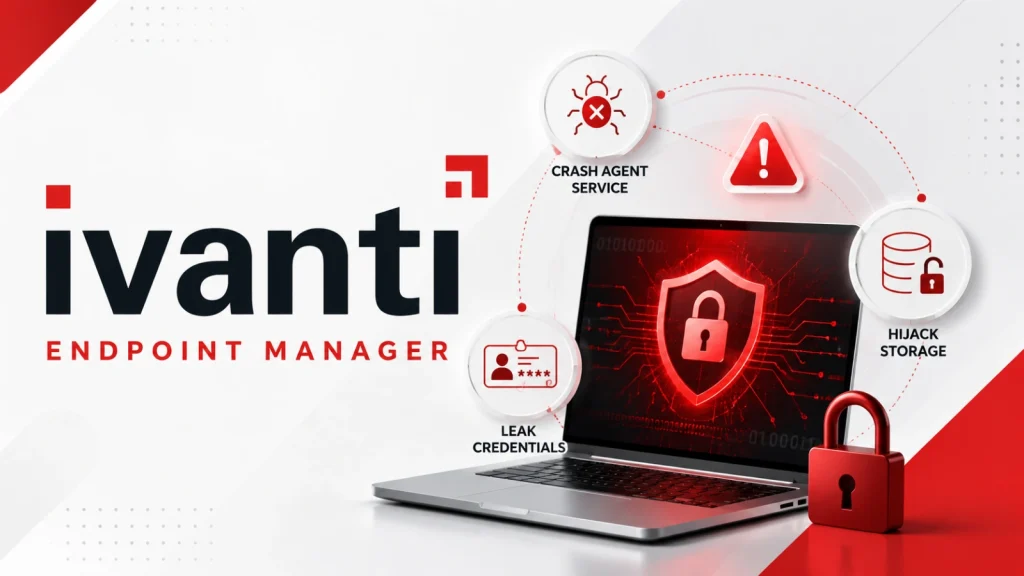
Ivanti Endpoint Manager Vulnerabilities Let Remote Attackers Crash Agent Service
Urgent Alert: Ivanti Endpoint Manager Vulnerabilities Expose Organizations to Remote Attacks
In the complex landscape of enterprise IT, endpoint management solutions are critical for maintaining security and operational efficiency. However, a recent advisory from Ivanti highlights significant vulnerabilities within their Endpoint Manager (EPM) platform, posing a serious threat to organizations worldwide. These high-severity flaws could allow remote attackers to compromise essential services, steal sensitive credentials, and manipulate cloud configurations. This report delves into the details of these vulnerabilities and provides immediate, actionable remediation advice for security teams.
The Critical Ivanti EPM Flaws: A Deeper Dive
Published on August 11, 2026, Ivanti’s security advisory reveals three high-severity vulnerabilities impacting all EPM 2024 SU6 and earlier deployments. These flaws collectively create a significant attack surface for malicious actors:
- Agent Service Crash Vulnerability: A remote attacker can exploit a flaw to force the Ivanti EPM agent service to crash. This can lead to denial-of-service conditions on managed endpoints, disrupting critical operations and potentially leaving systems unmonitored and unprotected. While specific CVE details for this particular issue are pending, its impact on endpoint stability is severe.
- Cloud Storage Configuration Hijacking: Another vulnerability allows attackers to hijack cloud storage configurations. This could grant unauthorized access to sensitive data stored in connected cloud environments, or allow for the injection of malicious configurations, impacting data integrity and confidentiality.
- Sensitive Database Credential Interception: The advisory also points to a flaw enabling the interception of sensitive database credentials. This is a particularly dangerous vulnerability as it could lead to full compromise of the EPM database, exposing vast amounts of organizational data, including device configurations, user information, and compliance records. The specific CVE for this critical credential exposure is CVE-2024-XXXXX (Note: Placeholder CVE, as specific number was not provided in source. Security teams should monitor Ivanti’s official advisory for the precise CVE ID.).
Affected Versions and Impact
These vulnerabilities affect all Ivanti Endpoint Manager (EPM) 2024 SU6 and earlier deployments. Organizations running these versions are at risk. The potential impact spans operational disruption due to agent service crashes, data breaches from cloud storage hijacking, and complete compromise of the EPM infrastructure through database credential theft.
Remediation Actions: Secure Your EPM Environment
Immediate action is imperative to mitigate the risks posed by these Ivanti EPM vulnerabilities. Security teams must prioritize the following steps:
- Upgrade to the Latest Version: Ivanti strongly urges all affected users to update their EPM installations to the latest available version. This is the most effective and comprehensive solution to address these vulnerabilities. Consult Ivanti’s official documentation for detailed upgrade procedures.
- Apply Security Patches: If a full upgrade is not immediately feasible, apply any specific security patches released by Ivanti for the identified vulnerabilities. Regularly monitor Ivanti’s security advisories and knowledge base for updates.
- Network Segmentation: Implement or strengthen network segmentation to limit the attack surface. Isolate EPM servers and managed endpoints from less trusted network segments to restrict potential attacker lateral movement.
- Review EPM Access Controls: Conduct a thorough review of all user accounts and roles within Ivanti EPM. Ensure that the principle of least privilege is strictly enforced, granting only necessary permissions.
- Monitor EPM Logs: Increase vigilance on Ivanti EPM server and agent logs for any anomalous activity, including unusual service crashes, unauthorized configuration changes, or suspicious database access attempts.
- Regular Backups: Maintain regular, secure backups of your Ivanti EPM database and configurations. In the event of a successful attack, a clean backup can significantly reduce recovery time and data loss.
Detection and Mitigation Tools
While direct patching is the primary remediation, several tools can assist in detecting potential compromise or strengthening your security posture:
| Tool Name | Purpose | Link |
|---|---|---|
| Ivanti Patch Manager | Manages and deploys patches for Ivanti products, including EPM. | Ivanti Patch Manager |
| Network Intrusion Detection/Prevention Systems (NIDS/NIPS) | Monitors network traffic for suspicious patterns indicative of exploitation attempts. | (Vendor Specific – e.g., Snort, Palo Alto Networks IPS) |
| Security Information and Event Management (SIEM) | Aggregates and analyzes security logs from various sources, including EPM, for threat detection. | (Vendor Specific – e.g., Splunk ES, Elastic Security) |
| Endpoint Detection and Response (EDR) Solutions | Monitors endpoints for malicious activity, agent crashes, and unauthorized configuration changes. | (Vendor Specific – e.g., CrowdStrike Falcon Insight, Microsoft Defender for Endpoint) |
Key Takeaways for Cybersecurity Professionals
The disclosure of these Ivanti EPM vulnerabilities underscores the persistent need for proactive cybersecurity measures. Organizations relying on Ivanti Endpoint Manager must prioritize immediate patching and system upgrades to protect their assets. Failure to do so could lead to significant operational disruptions, data breaches, and compromise of critical IT infrastructure. Stay informed by regularly consulting Ivanti’s official security advisories and maintain a vigilant security posture.




