
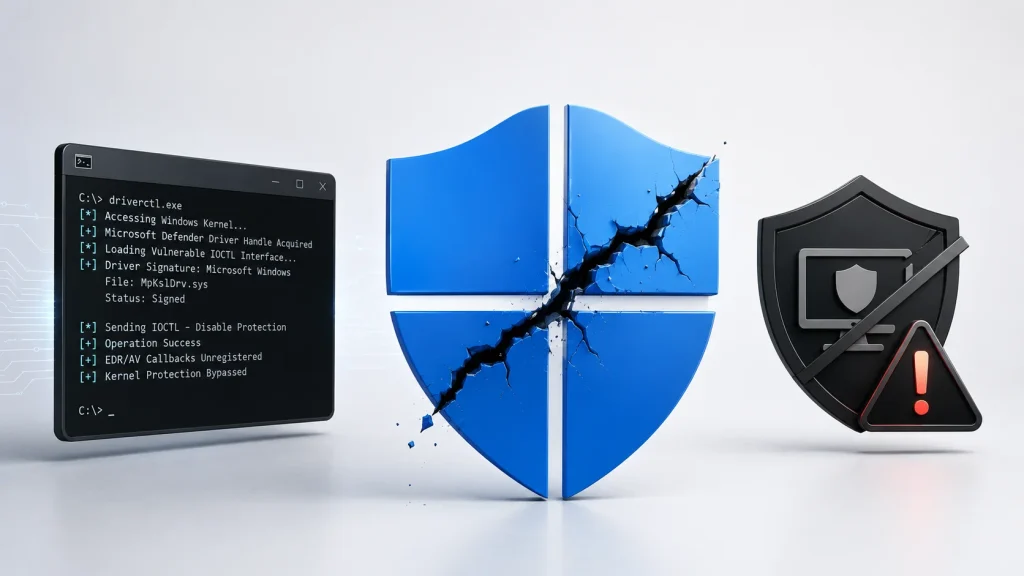
Microsoft Defender Driver Can Be Weaponized to Disable EDR and AV From Windows Kernel
The Trojan Within: How Microsoft Defender’s BTR.sys Driver Becomes a Weapon Against EDR
In the constant cat-and-mouse game of cybersecurity, attackers are always seeking novel ways to bypass defenses. A recent discovery from Check Point Research has shed light on a particularly insidious method: the repurposing of a legitimate Microsoft Defender driver, BTR.sys, to disarm endpoint security solutions. This isn’t a traditional vulnerability, but rather a chilling example of “Living-off-the-Land” (LotL) where trusted components are turned against the very systems they’re designed to protect. For IT professionals, security analysts, and developers, understanding this technique is crucial for building more resilient defense strategies.
Understanding the BTR.sys Driver and Its Intended Purpose
Microsoft Defender, a cornerstone of Windows security, utilizes various drivers to perform its functions. One such driver is BTR.sys, or Boot-Time Removal. As its name suggests, its primary role is to facilitate the removal of malicious files or registry entries during the boot process, often before other security software has fully loaded. This gives Defender a powerful, low-level capability to clean up persistent threats that might otherwise evade detection or removal by user-mode applications. It operates with kernel-level privileges, granting it significant control over the operating system’s core functions.
Weaponizing a Trusted Component: The Attack Vector
The Check Point research highlights that the power of BTR.sys, designed for good, can be subverted for malicious purposes. Attackers with existing administrative privileges on a compromised system can manipulate this legitimate, Microsoft-signed driver. Instead of using it to remove malware, they can instruct it to perform destructive kernel-level file and registry operations against Endpoint Detection and Response (EDR) and Antivirus (AV) solutions. This effectively allows them to:
- Disable security software processes.
- Delete critical EDR/AV files.
- Modify or remove registry entries essential for security software functionality.
- Interfere with security software’s ability to monitor system activity.
This attack vector is particularly dangerous because it leverages a component that is inherently trusted by the operating system and often whitelisted by other security products. It doesn’t exploit a memory corruption flaw or a typical vulnerability; rather, it exploits the design and capabilities of a legitimate tool. This technique aligns perfectly with LotL tactics, making detection more challenging as the activities appear to originate from a signed and trusted Microsoft process.
Why This Threat is Not a Conventional Vulnerability
It’s important to clarify that this discovery does not represent a conventional vulnerability in the sense of a CVE (Common Vulnerabilities and Exposures) record. There’s no specific CVE-202X-XXXXX to patch here. Instead, it’s a demonstration of how legitimate, powerful system tools can be abused. The issue lies not in a flaw within BTR.sys itself, but in the potential for an already compromised system to misuse its kernel-level capabilities. This underscores a broader challenge in cybersecurity: the line between legitimate system activity and malicious activity can become blurred when attackers utilize native tools.
Impact on Endpoint Security
The implications for endpoint security are significant. EDR and AV solutions rely heavily on their ability to maintain a persistent presence and monitor system activity. If an attacker can successfully leverage BTR.sys to disable these protections at the kernel level, it creates a critical window of opportunity for further malicious activity, including:
- Lateral movement within the network.
- Data exfiltration.
- Installation of additional malware.
- Establishment of long-term persistence mechanisms.
This technique elevates the importance of preventing initial administrative privilege escalation, as that is the prerequisite for weaponizing the BTR.sys driver.
Remediation Actions and Mitigation Strategies
While there isn’t a “patch” for this specific technique, several proactive measures can significantly reduce the risk:
- Principle of Least Privilege (PoLP): Strictly enforce PoLP for all user accounts and applications. Attackers need administrative privileges to weaponize
BTR.sys. Limiting these privileges reduces the attack surface. - Strong Access Controls: Implement robust access controls and regularly audit permissions on critical system files and directories, especially those related to security software.
- Proactive Threat Hunting: Security teams should engage in proactive threat hunting, looking for anomalies that might indicate the misuse of legitimate tools. This includes monitoring for unusual driver loads, unusual processes interacting with security software, and unexpected file/registry modifications.
- Behavioral Monitoring: Advanced EDR solutions often include behavioral monitoring capabilities that can detect suspicious activities even if they originate from a trusted process. Look for unusual sequences of operations, even if individual actions are legitimate.
- System Hardening: Implement comprehensive system hardening guidelines, including disabling unnecessary services, regularly patching all software, and using application whitelisting where feasible to prevent unauthorized executables from running.
- Regular Auditing and Logging: Ensure comprehensive logging is enabled for driver loading, process creation, file system changes, and registry modifications. Regularly review these logs for suspicious patterns.
- Network Segmentation: Segment your network to limit lateral movement potential, even if an endpoint’s security is temporarily compromised.
Detection and Mitigation Tools
While no specific tool directly “patches” this LotL technique, several categories of tools are essential for detecting and mitigating the associated risks:
| Tool Category | Purpose | Examples |
|---|---|---|
| Advanced EDR Platforms | Detecting behavioral anomalies, process injection, unusual driver loading, and attempts to tamper with security software. | CrowdStrike Falcon, SentinelOne, Microsoft Defender for Endpoint |
| SIEM/SOAR Solutions | Aggregating and analyzing logs from endpoints, network devices, and security tools to identify suspicious patterns and facilitate automated responses. | Splunk, IBM QRadar, Microsoft Sentinel |
| Endpoint Hardening Tools | Enforcing security configurations, managing application whitelisting, and ensuring adherence to security baselines. | Group Policy, Microsoft Intune, CIS Benchmarks |
| Vulnerability Management Platforms | Identifying and prioritizing vulnerabilities that could lead to initial administrative privilege escalation, which is a prerequisite for this attack. | Tenable.io, Qualys, Rapid7 InsightVM |
Conclusion
The discovery that Microsoft Defender’s legitimate BTR.sys driver can be weaponized to neutralize EDR and AV solutions underscores a critical evolution in the threat landscape. Attackers are increasingly moving beyond traditional exploits to leverage trusted system components, blurring the lines between legitimate and malicious activity. This “Living-off-the-Land” technique highlights the importance of a defense-in-depth strategy that goes beyond signature-based detection. Organizations must focus on robust access control, continuous monitoring for behavioral anomalies, comprehensive logging, and rigorous system hardening to thwart such sophisticated attacks. Protecting against the abuse of trusted tools requires a deeper understanding of how an operating system functions and a proactive stance against any attempts to gain unauthorized control.




