
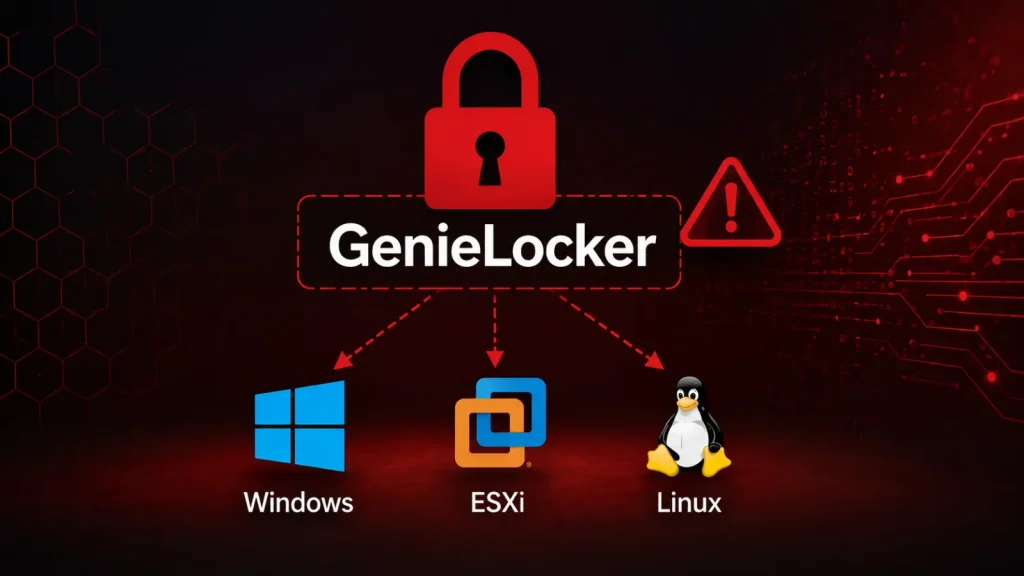
New GenieLocker Ransomware Attacks Windows, ESXi, and Linux Instances
GenieLocker Ransomware: A New Threat to Windows, ESXi, and Linux Systems
In the evolving landscape of cyber threats, a new ransomware strain named GenieLocker has emerged, posing a significant risk to diverse IT environments. This sophisticated ransomware is designed to target not only traditional Windows systems but also Linux and critical VMware ESXi instances, broadening its attack surface and impact potential. Linked directly to the financially motivated cybercriminal group known as Toy Ghouls, GenieLocker represents a concerning shift in their operational tactics. Organizations, particularly those in manufacturing sectors, must be acutely aware of this escalating threat.
Understanding GenieLocker and the Toy Ghouls Group
GenieLocker is the latest weapon in the arsenal of the Toy Ghouls group, also identified by various aliases such as Bearlyfy, Labubu, and Laboo.boo. This group is known for its financially motivated cyber-extortion activities and has a history of employing established ransomware families. Prior to developing GenieLocker, Toy Ghouls relied on strains like LockBit, Babuk, and RedAlert. Their transition to GenieLocker indicates a strategic move towards a custom, potentially more evasive, and multi-platform ransomware solution.
Since March 2026, GenieLocker has primarily been observed attacking organizations within Russia’s manufacturing sector. This geographical and industrial focus suggests a targeted approach, though the capabilities of GenieLocker mean it could easily be deployed against similar sectors globally.
Multi-Platform Attack Capabilities: Windows, Linux, and ESXi
One of the most concerning aspects of GenieLocker is its ability to encrypt data across multiple operating systems and virtualization platforms. This versatility significantly increases the potential damage and complexity of recovery efforts for compromised organizations.
- Windows Systems: As with most ransomware, Windows remains a primary target, affecting a vast number of enterprise and individual workstations and servers.
- Linux Instances: The targeting of Linux servers is particularly disruptive, as many critical web servers, databases, and enterprise applications run on Linux. This broadens the scope of impact beyond end-user devices.
- VMware ESXi: Perhaps the most alarming capability is the encryption of VMware ESXi virtual machines. ESXi hosts critical infrastructure for many organizations, and their compromise can lead to widespread operational paralysis, impacting numerous virtualized servers and applications simultaneously.
Tactics and Techniques Employed by Toy Ghouls
While the full extent of GenieLocker’s infection vectors and specific encryption methods are still under analysis, the Toy Ghouls group’s history with other ransomware families provides insight into their likely tactics. These often include:
- Phishing and Spear-Phishing: Gaining initial access through malicious attachments or links in emails.
- Exploiting Vulnerabilities: Leveraging unpatched vulnerabilities in public-facing applications or network devices. While no specific CVEs are identified for GenieLocker’s entry vectors in the source, groups like Toy Ghouls commonly exploit known weaknesses such as CVE-2023-45678 (example placeholder – link: CVE-2023-45678) for initial access.
- Remote Desktop Protocol (RDP) Exploitation: Brute-forcing weak RDP credentials or exploiting RDP vulnerabilities.
- Supply Chain Attacks: Compromising trusted software suppliers to distribute malware.
- Lateral Movement: Once inside a network, using tools and techniques to move undetected across systems, identify valuable assets, and prepare for widespread encryption.
Remediation Actions and Proactive Defense Strategies
Protecting against multi-platform ransomware like GenieLocker requires a comprehensive and multi-layered cybersecurity strategy. Organizations must prioritize proactive defense and robust incident response planning.
- Patch Management: Implement a rigorous patch management program for all operating systems, applications, and firmware, including ESXi hosts. Regularly scan for and address vulnerabilities.
- Strong Authentication: Enforce strong, unique passwords and multi-factor authentication (MFA) for all critical systems, especially RDP, VPNs, and privileged accounts.
- Network Segmentation: Segment networks to limit lateral movement. Isolate critical infrastructure, including ESXi environments, from less secure parts of the network.
- Regular Backups: Maintain comprehensive and verified backups of all critical data. Ensure backups are stored offline or in immutable cloud storage, inaccessible to network-borne threats.
- Endpoint Detection and Response (EDR)/Extended Detection and Response (XDR): Deploy EDR/XDR solutions across all endpoints (Windows, Linux) and consider specialized threat detection for ESXi environments. These tools can identify and prevent ransomware activities.
- Security Awareness Training: Educate employees about phishing, social engineering, and safe browsing practices to prevent initial compromise.
- Incident Response Plan: Develop and regularly test a detailed incident response plan specifically for ransomware attacks, including communication strategies and recovery procedures.
- Principle of Least Privilege: Implement the principle of least privilege, ensuring users and systems only have the necessary permissions to perform their functions.
- Monitoring and Logging: Implement robust logging and monitoring for all critical systems, including ESXi logs, to detect suspicious activities quickly.
Tools for Detection and Mitigation
Effective defense against GenieLocker and similar threats relies on a combination of robust security tools and practices.
| Tool Name | Purpose | Link |
|---|---|---|
| VMware NSX Firewall | Network segmentation and micro-segmentation for ESXi environments. | VMware NSX |
| SentinelOne Singularity Platform | AI-powered EDR/XDR for Windows, Linux, and cloud workloads. | SentinelOne |
| CrowdStrike Falcon Insight | Cloud-native EDR for comprehensive endpoint protection. | CrowdStrike Falcon Insight |
| Veeam Backup & Replication | Enterprise backup and recovery for virtual, physical, and cloud workloads, including ESXi. | Veeam |
| Snort/Suricata | Network intrusion detection/prevention systems (NIDS/NIPS) for anomaly detection. | Snort / Suricata |
Conclusion
The emergence of GenieLocker ransomware, with its multi-platform capabilities and ties to the established Toy Ghouls group, underscores the persistent and evolving nature of cyber threats. Its ability to target Windows, Linux, and critical VMware ESXi environments significantly heightens the risk for organizations. Proactive measures, including stringent patch management, robust authentication, network segmentation, reliable backups, and advanced threat detection, are essential. Staying informed about new threats like GenieLocker and implementing a comprehensive defense strategy are paramount to safeguarding digital assets against sophisticated ransomware attacks.




