
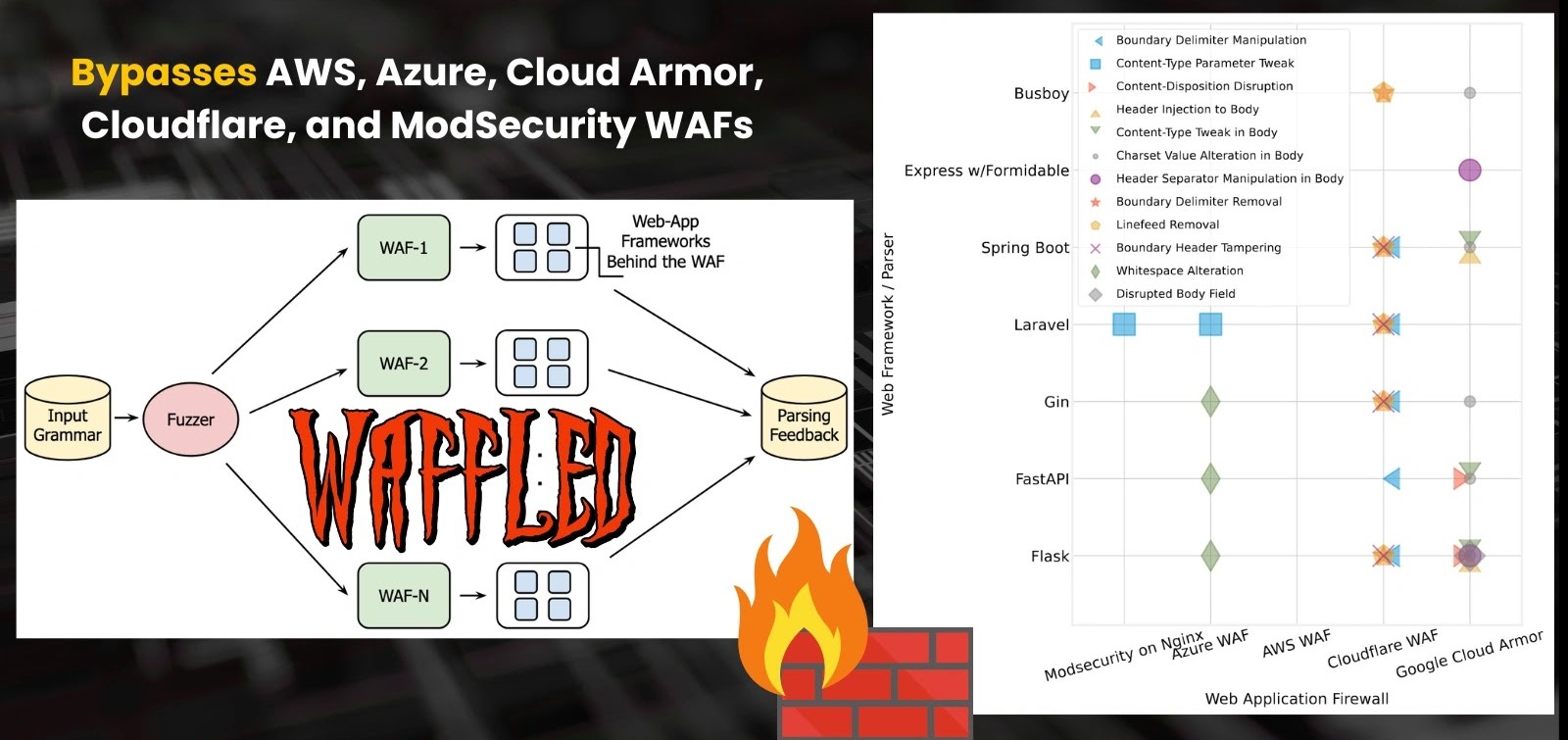
New WAFFLED Attack Exploits AWS, Azure, Cloud Armor, Cloudflare, and ModSecurity WAFs
Unmasking WAFFLED: A New WAF Evasion Technique Bypassing Leading Cloud Security
In the relentless pursuit of robust web application security, Web Application Firewalls (WAFs) stand as critical frontline defenses. Yet, a recently disclosed technique, dubbed WAFFLED, has sent ripples through the cybersecurity community. This innovative attack showcases a concerning ability to bypass prominent WAFs, including those underpinning services like AWS, Azure, Cloud Armor, Cloudflare, and even ModSecurity. Understanding WAFFLED is paramount for any organization serious about protecting its digital assets.
The essence of WAFFLED lies not in tampering with the malicious payload itself, but in exploiting subtle parsing inconsistencies between a WAF and the backend application. By meticulously mutating seemingly innocuous elements within standard web request formats, attackers can craft requests that appear benign to the WAF, while the true malicious intent remains completely intact and delivers its payload to the vulnerable application. This sophisticated method highlights a fundamental challenge in WAF design and configuration.
How WAFFLED Waffles Leading WAFs: The Art of Subtle Manipulation
WAFFLED leverages the intricate dance between web protocols and their various implementations. Instead of directly obfuscating or encrypting the malicious payload, the attack focuses on manipulating the surrounding “packaging” of the request. Consider how a WAF might interpret a request versus how the destination web server or application framework parses it. This discrepancy is the attack’s sweet spot.
Specifically, WAFFLED targets:
- Multipart/form-data boundary delimiters: In requests carrying file uploads or complex form data, WAFs and applications might handle slight variations or irregularities in boundary markers differently. WAFFLED exploits these nuances to present an innocent-looking structure to the WAF, only for the application to reconstruct the malicious payload due to its more lenient parsing.
- Application/json character sets: JSON, a ubiquitous data interchange format, has specific rules for character encoding. An attacker can introduce subtly malformed characters or non-standard encodings that a WAF might sanitize or reject, but a tolerant application parser might interpret in a way that reconstructs the attack.
- Application/xml namespace features: XML, though less common than JSON for new applications, still powers many enterprise systems. WAFFLED leverages the complexities of XML namespaces, where a slight deviation in definition or reference can lead to a WAF either misinterpreting the structure or failing to fully inspect its content, while the application correctly processes the harmful element.
The genius of WAFFLED is its subtlety. It doesn’t scream “attack.” Instead, it whispers “benign,” tricking the WAF into believing the request is safe to pass through, thus enabling the hidden malicious payload to reach its target.
Impact and Implications for Cloud Security
The ability of WAFFLED to bypass WAFs from major cloud providers and widely deployed open-source solutions is a significant concern. Organizations relying on these WAFs as their primary layer of defense against common web attacks such as SQL injection, Cross-Site Scripting (XSS), and Remote Code Execution (RCE) are at heightened risk. While the specifics of the exploited vulnerabilities are not directly tied to a singular CVE for the WAFFLED technique itself (as it describes a class of evasion), the underlying parsing inconsistencies often stem from how various parsers handle RFC deviations or edge cases.
This attack reinforces the understanding that WAFs are not a silver bullet. While invaluable for filtering known attack patterns, their effectiveness can be undermined by sophisticated evasion techniques that exploit parsing discrepancies beyond pattern matching. For instance, an attack that exploits CVE-2021-44228 (Log4Shell) could, in theory, be disguised using WAFFLED techniques to bypass WAF rules designed to detect Log4Shell payloads directly.
Remediation Actions and Mitigations Against WAFFLED
Addressing WAFFLED requires a multi-faceted approach that extends beyond simple WAF rule updates. Organizations need to focus on hardening their entire web application stack.
- Strict Input Validation and Sanitization: This remains the bedrock of web application security. Ensure that all user-supplied input, regardless of its source (form data, JSON, XML, headers), is rigorously validated against expected formats, lengths, and character sets. Reject anything that doesn’t conform. Implement comprehensive sanitization routines that remove or neutralize potentially malicious characters or structures before processing.
- Least Privilege and Zero Trust: Even if an attack bypasses the WAF, limiting the privileges of the application and its underlying services can significantly reduce the potential damage. Adopt a Zero Trust architecture, verifying every request and connection, even from inside the network perimeter.
- Regular Patching and Updates: Keep all web servers, application frameworks, libraries, and WAF software updated to the latest versions. Vendors frequently release patches that address parsing vulnerabilities and improve WAF Rule Sets.
- Behavioral Monitoring and Anomaly Detection: While WAFFLED evades signature-based WAF rules, it might still generate anomalous behavior on the backend. Implement robust logging and monitoring solutions that can detect unusual request patterns, unexpected error messages, or suspicious application behavior that might indicate a successful evasion.
- Defense in Depth: Relying solely on a WAF is insufficient. Employ multiple layers of security, including network segmentation, API gateways with strong authentication and authorization, and runtime application self-protection (RASP) technologies that can detect and prevent attacks from within the application’s execution environment.
- WAF Tuning and Rule Enhancements: While WAFFLED specifically targets WAF parsing, work with your WAF vendor or security team to review and potentially enhance your WAF rules beyond signature-based detection. Explore advanced WAF features such as API security modules, bot mitigation, and advanced traffic analysis that might detect the subtle characteristics of WAFFLED-like attacks.
- Developer Education: Educate developers on secure coding practices, common input validation pitfalls, and the nuances of various content-type parsing. Understanding how subtle parsing differences can lead to security vulnerabilities is crucial.
Tools for Detection and Mitigation
While WAFFLED is a technique rather than a specific vulnerability, several tools can assist in detecting related attack vectors or improving overall application security posture:
| Tool Name | Purpose | Link |
|---|---|---|
| OWASP ZAP (Zed Attack Proxy) | Web application security scanner to find vulnerabilities, including those related to input validation and misconfigurations. | https://www.zaproxy.org/ |
| Burp Suite Community/Pro | Intercepting proxy and web vulnerability scanner, invaluable for manual testing and understanding request parsing. | https://portswigger.net/burp |
| ModSecurity | Open-source WAF, whose rule sets can be customized to mitigate parsing issues if meticulously configured. | https://modsecurity.org/ |
| Nessus/OpenVAS | Vulnerability scanners capable of identifying many common web application vulnerabilities that could be exploited via WAFFLED. | https://www.tenable.com/products/nessus http://www.openvas.org/ |
| Application Performance Monitoring (APM) tools (e.g., Dynatrace, New Relic) | Monitor application behavior in real-time, helping detect anomalies that could signal a successful WAF evasion. | https://www.dynatrace.com/ https://newrelic.com/ |
Looking Ahead: The Evolving WAF Landscape
The WAFFLED technique serves as a powerful reminder that the cybersecurity arms race is far from over. As WAFs become more sophisticated, so do the evasion methods employed by attackers. Organizations must move beyond a perimeter-only security mindset and embrace a holistic defense-in-depth strategy. Continuous vigilance, proactive patching, robust input validation, and ongoing security testing are non-negotiable in the face of evolving threats like WAFFLED. The focus must shift from merely blocking known signatures to understanding how applications process data, ensuring consistent and secure parsing across the entire request lifecycle.