
ODINI Malware Exploits CPU Magnetic Emissions to Breach Faraday-Shielded Air-Gapped Computers
Unveiling ODINI: The Covert Threat That Reaches Beyond Faraday Cages
The concept of an air-gapped computer has long been considered the pinnacle of cybersecurity, a digital fortress designed to physically isolate critical systems from external networks and even electromagnetic interference. Yet, a groundbreaking proof-of-concept malware named ODINI is challenging this fundamental assumption, demonstrating a chilling capability to extract sensitive information from these seemingly impenetrable machines. This sophisticated threat, originating from innovative research, leverages an entirely new attack vector: the subtle magnetic emissions produced by a computer’s Central Processing Unit (CPU).
At its core, ODINI highlights a critical evolving frontier in adversarial tactics, where physical and digital realms intersect in unexpected ways. This article delves into the mechanics of ODINI, its implications for high-security environments, and crucial steps organizations can take to bolster their defenses against such advanced persistent threats.
What is ODINI?
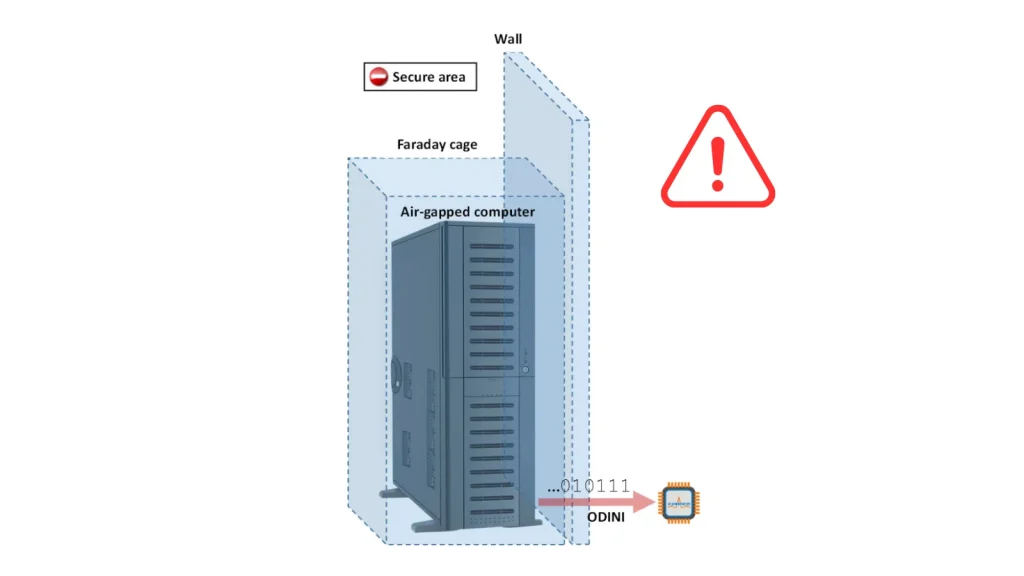
ODINI is not your typical network-based malware. Developed by a team led by the renowned cybersecurity researcher Mordechai Guri at Israel’s Ben-Gurion University, ODINI is a proof-of-concept malware designed to bypass the most stringent physical security measures, including Faraday cages. Its ingenuity lies in its ability to transform a computer’s operational byproducts—specifically, electromagnetic emissions—into a covert data exfiltration channel.
The malware operates by precisely modulating the workload of the targeted computer’s CPU. This controlled manipulation generates varying patterns of low-frequency magnetic fields. These magnetic fluctuations, imperceptible through conventional means, are then interpreted by a nearby receiver, effectively transmitting data in a manner akin to Morse code, but through a previously unexploited physical medium.
This technique is particularly alarming because it undermines the very principle of air-gapping, which relies on physical isolation to prevent data leakage. The use of magnetic emissions as a side-channel attack vector represents a significant paradigm shift in how we must conceive of and defend against highly determined adversaries.
How ODINI Leverages CPU Magnetic Emissions for Data Exfiltration
The mechanism behind ODINI is both elegant and insidious. Modern CPUs are highly complex electrical circuits, and their operation generates measurable electromagnetic fields. While these emissions are typically considered benign noise, ODINI transforms them into a deliberate communication channel.
- Workload Modulation: The malware manipulates the CPU’s processing load. By executing specific instruction sets or computational tasks, ODINI can vary the power consumption and, consequently, the magnetic field strength emitted by different components within the CPU.
- Generating Patterns: These variations are not random. ODINI orchestrates these changes to encode binary data (0s and 1s) into distinct magnetic patterns. For instance, a high computational load might represent a ‘1’, while a lower load could represent a ‘0’.
- Low-Frequency Transmission: The magnetic fields generated are in the low-frequency spectrum, which possesses a critical advantage: it can penetrate physical barriers that would typically block radio frequencies, including the conductive mesh of a Faraday cage.
- External Receiver: For data exfiltration to occur, an external receiver equipped with specialized magnetic coil sensors must be positioned in relative proximity to the compromised air-gapped computer. This receiver detects and demodulates the magnetic signals, translating them back into the exfiltrated data.
This method circumvents traditional network intrusion detection systems, firewalls, and even physical security protocols designed to prevent wireless transmissions. The data transfer rate, while likely slow compared to network-based exfiltration, is sufficient for leaking critical sensitive information over time.
The Threat to Faraday-Shielded Systems
Faraday cages are designed to block electromagnetic fields, offering a high level of protection against eavesdropping and electromagnetic interference. They are fundamental to securing highly sensitive data in government, military, research, and critical infrastructure sectors. The ability of ODINI to penetrate these shields presents a grave challenge to established security paradigms.
The primary reason ODINI bypasses Faraday cage protection is due to the nature of the emissions it exploits. While Faraday cages are highly effective at attenuating high-frequency electromagnetic waves (like Wi-Fi or cellular signals), their effectiveness can be significantly reduced for very low-frequency magnetic fields. The exact attenuation depends on the cage’s material, design, and frequency range, but the principle remains: magnetic fields at certain low frequencies can “leak” through or induce currents that are then picked up.
This research underscores a critical vulnerability in the assumption that physical isolation alone guarantees security against all forms of data leakage, especially when a determined adversary can leverage unconventional physical channels.
Remediation Actions and Mitigations
Combating threats like ODINI requires a multi-layered approach that considers not just software and network security, but also the physical environment and hardware characteristics. While direct CVEs are not typically assigned to research proofs-of-concept like ODINI until they manifest as real-world exploits in specific products, the underlying principles highlight vulnerabilities that organizations must address.
For systems potentially vulnerable to side-channel attacks like ODINI, consider the following:
- Physical Isolation Enhancement: Beyond traditional Faraday cages, explore additional magnetic shielding for critical components or entire server racks. This might involve specialized alloys or active magnetic field cancellation technologies.
- Hardware Monitoring: Implement advanced hardware-level monitoring solutions that can detect abnormal CPU workload patterns, even on isolated systems. Deviations from baseline operational profiles could indicate malicious activity.
- Electromagnetic Environment Assessment: Conduct regular assessments of the electromagnetic environment surrounding air-gapped systems. Specialized equipment can detect unusual magnetic flux variations.
- Reduced EMI/EMC Hardware: Prioritize hardware components (CPUs, motherboards, power supplies) that are designed for minimal electromagnetic interference (EMI) and comply with stringent electromagnetic compatibility (EMC) standards.
- Physical Security Protocols: Reinforce strict physical access controls to air-gapped environments. The attacker still requires proximity for the receiver. Implement secure zones and regular sweeps for unauthorized devices.
- Software Integrity Checks: Maintain robust software integrity measures, including whitelisting applications and performing regular checksum verifications on critical system files to detect any unauthorized modifications (the initial infection vector).
- Research and Development: Stay informed on ongoing research in side-channel attacks and electromagnetic security. Collaboration with cybersecurity research institutions can provide early insights into emerging threats.
Tools for Electromagnetic Security Assessment
While ODINI itself isn’t a vulnerability with a direct patch, the principles it demonstrates highlight the need for advanced physical and electromagnetic security assessments. The following tools can assist in understanding and mitigating electromagnetic vulnerabilities:
| Tool Name | Purpose | Link |
|---|---|---|
| Spectrum Analyzers | Detect and analyze electromagnetic emissions across various frequencies. Essential for identifying unusual EM activity. | Wikipedia – Spectrum Analyzer |
| Near-Field Probes | Used with spectrum analyzers to pinpoint exact sources of EM emissions on circuit boards and components. | Wikipedia – Near-Field Probe |
| Magnetic Field Sensors (e.g., Fluxgate, GMR sensors) | High-sensitivity sensors for detecting subtle magnetic field variations, useful for research and specialized monitoring. | Wikipedia – Magnetometer |
| EMC Test Chambers | Controlled environments for testing and certifying equipment against electromagnetic compatibility standards. | Wikipedia – EMC |
Looking Ahead: The Evolving Landscape of Air-Gap Security
The emergence of ODINI serves as a stark reminder that the battle for cybersecurity is unrelenting and constantly evolving. As digital defenses become more robust, adversaries will invariably explore creative, often physical, means to achieve their objectives. The concept of an “air gap” must now be re-evaluated to encompass not just network isolation, but also comprehensive electromagnetic and acoustic isolation.
Organizations safeguarding highly sensitive data must transition from merely preventing network intrusions to proactively managing their entire physical and electromagnetic attack surface. The research behind ODINI pushes the boundaries of what’s considered possible for data exfiltration, demanding renewed vigilance and innovative defense strategies in the protection of critical air-gapped systems.




