
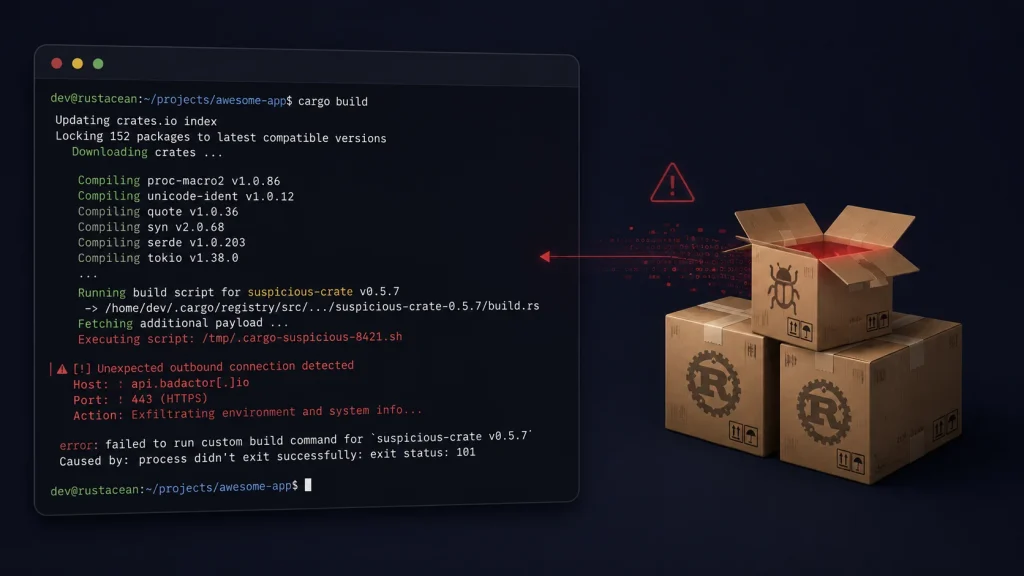
Popular Rust Packages With 244M Downloads Compromised to Run Malware
A Pervasive Threat: Rust Supply Chain Compromise Impacts Millions of Downloads
The integrity of the software supply chain remains a critical concern for developers and security professionals alike. A recent incident has sent ripples through the Rust ecosystem, highlighting the persistent danger of malicious package injections. Two widely adopted Rust crates, arrayref and append-only-vec, were compromised, silently delivering malware to developers upon project compilation. This sophisticated attack, affecting packages with a combined download count exceeding 244 million, represents one of the most significant Rust crate compromises ever recorded by sheer volume, underscoring the vital need for vigilant supply chain security.
Understanding the Rust Supply Chain Attack
This incident involved the hijacking of popular Rust packages, a classic example of a software supply chain attack. In such an attack, adversaries compromise legitimate software components, often open-source libraries or frameworks, to distribute malicious code. Developers, unknowingly incorporating these compromised components into their projects, then inadvertently become vectors for malware delivery. The scale of this particular attack is alarming due to the widespread adoption of the affected crates. The arrayref crate, for instance, provides utilities for safe array referencing, a common operation in many Rust applications. Similarly, append-only-vec offers a specialized vector implementation. Their widespread use made them attractive targets for attackers seeking maximum impact.
While specific details regarding the payload and its capabilities are still emerging, the modus operandi suggests an attempt to establish persistence or exfiltrate sensitive data from developer machines. Such attacks can lead to intellectual property theft, credential compromise, or the further propagation of malware within an organization’s network. The silent nature of the injection, occurring during the compilation phase, makes it particularly insidious, bypassing traditional runtime security measures.
The Mechanics of Compromise: How Malicious Code Infiltrated Popular Crates
The exact vector for gaining control over the arrayref and append-only-vec crates has not been publicly detailed. However, common methods for such takeovers include:
- Credential Theft: Attackers gaining unauthorized access to maintainers’ accounts on crate registries like crates.io.
- Social Engineering: Tricking maintainers into granting access or installing malicious tools.
- Dependency Confusion: Exploiting misconfigurations to trick build systems into downloading malicious private packages instead of legitimate public ones.
- Typo Squatting: Registering similarly named crates to trick developers.
Once control was established, the attackers injected malicious code directly into the crate’s source. When a developer compiles a project that depends on a compromised version of arrayref or append-only-vec, the malicious code is executed as part of the build process. This could involve downloading additional payloads, modifying system configurations, or initiating covert communication channels. The vast download numbers indicate a significant potential blast radius, affecting numerous projects and potentially thousands of developers.
Remediation Actions and Best Practices for Rust Developers
Addressing this type of supply chain compromise requires immediate action and a shift towards proactive security measures. Here are essential steps for Rust developers and organizations:
- Audit Dependencies: Immediately review your project’s
Cargo.lockfile andCargo.tomlto identify if you are directly or indirectly dependent on affected versions ofarrayreforappend-only-vec. While CVE numbers are not yet officially assigned for this specific incident, developers should monitor advisories from crates.io and security researchers. - Update Crates: Ensure all dependencies are updated to their latest, secure versions. Crate maintainers typically release patched versions promptly after a compromise is detected. Always check release notes for security fixes.
- Implement Supply Chain Security Tools: Utilize tools that perform static analysis, dependency scanning, and software composition analysis (SCA) to identify known vulnerabilities and suspicious activity within your dependency tree.
- Pin Dependencies: For critical projects, consider pinning exact versions of dependencies in
Cargo.tomlto prevent automatic updates to potentially compromised versions without explicit review. However, balance this with the need to update for security patches. - Least Privilege Principles: Restrict network access and execution permissions during the build process to minimize the potential impact of a compromised dependency.
- Monitor Build Environments: Implement monitoring solutions for your CI/CD pipelines to detect anomalous network connections, file modifications, or process executions during the build phase.
- Educate Developers: Regularly train development teams on supply chain risks, secure coding practices, and the importance of verifying package sources.
- Use Private Registries: For enterprise environments, consider using a private crate registry that allows for closer vetting and scanning of packages before they are made available to internal developers.
Tools for Enhancing Rust Supply Chain Security
Leveraging specialized tools can significantly bolster your defense against supply chain attacks.
| Tool Name | Purpose | Link |
|---|---|---|
cargo audit |
Scans Cargo.lock for known security vulnerabilities. | https://github.com/RustSec/cargo-audit |
| Dependency-Track | Software Composition Analysis (SCA) platform for managing supply chain risk. | https://dependencytrack.org/ |
| OWASP Dependency-Check | Identifies project dependencies and checks for known vulnerabilities. | https://owasp.org/www-project-dependency-check/ |
| Snyk | Automated security for open source dependencies, code, and containers. | https://snyk.io/ |
| Mend (formerly WhiteSource) | Automates open source security and license compliance. | https://www.mend.io/ |
Looking Ahead: Fortifying the Rust Ecosystem Against Future Threats
This incident serves as a stark reminder that even robust and security-focused languages like Rust are not immune to supply chain attacks. The community’s rapid response and transparency are crucial in mitigating the immediate impact. However, the long-term solution lies in a multi-faceted approach involving better registry security, improved package signing mechanisms, and enhanced developer awareness. As software supply chains grow increasingly complex, fostering a culture of security throughout the entire development lifecycle becomes paramount. Proactive security practices, combined with community vigilance and robust tooling, are essential to safeguard the integrity of our software and protect against the ever-evolving landscape of cyber threats.




