
Ransomware Hackers Use New TukTuk Malware to Steal Credentials and Disable Security Tools
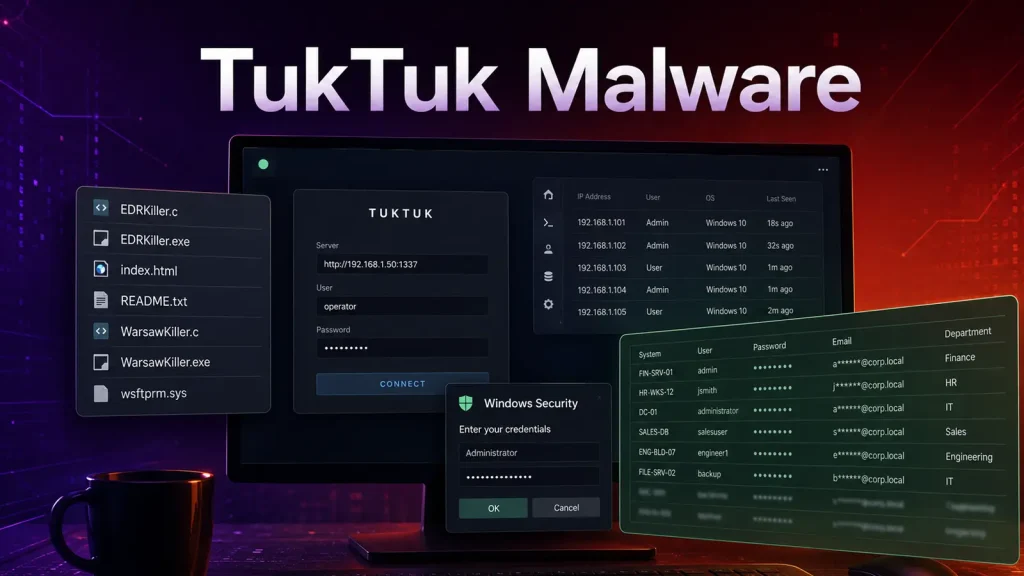
The cybersecurity landscape is constantly shifting, with threat actors continually refining their tactics. A recent discovery has unveiled a new and concerning remote-control framework named TukTuk malware. This sophisticated tool is being leveraged by ransomware operators, most notably those associated with the Gentlemen ransomware operation, to achieve a trifecta of malicious objectives: credential theft, system surveillance, and the disabling of critical security defenses. Understanding TukTuk’s capabilities is crucial for defenders looking to fortify their networks against these evolving threats.
Understanding the TukTuk Malware Framework
TukTuk is far from a simplistic piece of malware. It functions as a potent remote-control framework, granting attackers extensive control over compromised systems. This isn’t just about dropping ransomware; it’s about establishing a persistent foothold, gathering intelligence, and systematically weakening an organization’s security posture before the final, devastating payload is deployed. The discovery of TukTuk provides security analysts with an invaluable glimpse into the operational methodologies of these advanced persistent threats (APTs).
How TukTuk Facilitates Ransomware Operations
The integration of TukTuk into ransomware operations, particularly those linked to the Gentlemen ransomware, illustrates a strategic shift. Instead of relying solely on initial compromise and immediate encryption, threat actors are now investing in more thorough reconnaissance and preparation. Here’s a breakdown of its primary functions:
- Credential Theft: TukTuk is designed to exfiltrate sensitive login credentials. This can include usernames and passwords for local accounts, domain accounts, and even credentials stored in browsers or other applications. Stolen credentials allow attackers to move laterally across a network, escalate privileges, and access critical systems.
- System Surveillance: Beyond simply stealing data, TukTuk enables attackers to monitor compromised machines in real-time. This surveillance capability allows them to understand network topology, identify valuable data stores, observe user behavior, and strategize their next moves, all while remaining undetected for longer periods.
- Defense Evasion and Disablement: A critical aspect of TukTuk’s functionality is its ability to weaken and disable security tools. This includes antivirus software, endpoint detection and response (EDR) solutions, and even firewalls. By dismantling these protective layers, attackers significantly reduce the chances of early detection and intervention, paving the way for successful ransomware deployment.
The Link to Gentlemen Ransomware
The attribution of TukTuk to activities associated with the Gentlemen ransomware operation is a significant detail. It highlights how various sophisticated tools are often part of a broader arsenal used by specific threat groups. This connection allows cybersecurity professionals to track and anticipate the tactics, techniques, and procedures (TTPs) of this particular ransomware group more effectively. Understanding these affiliations helps in developing targeted defenses and threat intelligence.
Remediation Actions and Proactive Defenses
Defending against advanced threats like those employing TukTuk requires a multi-layered approach focusing on prevention, detection, and rapid response. Here are actionable steps organizations can take:
- Implement Strong Password Policies and Multi-Factor Authentication (MFA): Enforce complex passwords and mandate MFA for all critical systems and user accounts. This significantly increases the difficulty for attackers attempting to leverage stolen credentials.
- Regular Security Awareness Training: Educate employees about phishing, social engineering, and the importance of reporting suspicious activities. Many initial compromises occur through human error.
- Patch Management: Keep all operating systems, applications, and network devices fully patched. Vulnerabilities are frequently exploited as initial access vectors.
- Endpoint Detection and Response (EDR) Solutions: Deploy robust EDR solutions that can monitor endpoint activity, detect anomalous behavior, and provide immediate alerts for suspicious processes or attempts to disable security software.
- Network Segmentation: Segment your network to limit lateral movement. If one part of the network is compromised, segmentation can prevent attackers from easily reaching other critical areas.
- Principle of Least Privilege: Grant users and systems only the minimum necessary permissions to perform their functions. This limits the damage an attacker can inflict even if they gain access to an account.
- Regular Backups and Recovery Plans: Maintain offline, immutable backups of critical data and regularly test your disaster recovery plan. This is your last line of defense against data loss from ransomware.
- Monitor for Suspicious Activity: Implement robust logging and monitoring across your network. Look for unusual network traffic, unauthorized access attempts, and attempts to modify or disable security controls.
Detection and Mitigation Tools
Leveraging the right tools is essential for detecting and mitigating threats like TukTuk. Here’s a list of categories and examples:
| Tool Category | Purpose | Example Tools / Approaches |
|---|---|---|
| Endpoint Detection & Response (EDR) | Detects and responds to malicious activity on endpoints, including attempts to disable security tools. | CrowdStrike Falcon, SentinelOne, Microsoft Defender for Endpoint |
| Security Information and Event Management (SIEM) | Aggregates and analyzes security logs from across the IT infrastructure to detect threats. | Splunk, IBM QRadar, Microsoft Azure Sentinel |
| Vulnerability Scanners | Identifies weaknesses in systems that attackers might exploit for initial access. | Nessus, OpenVAS, Qualys VMDR |
| Network Intrusion Detection/Prevention Systems (NIDS/NIPS) | Monitors network traffic for suspicious patterns and known attack signatures. | Snort, Suricata, Palo Alto Networks NGFW |
| Identity and Access Management (IAM) | Manages digital identities and access privileges to ensure only authorized users access resources. | Okta, Microsoft Azure AD, Ping Identity |
Conclusion
The emergence of TukTuk malware signifies a clear evolution in ransomware attack methodologies. Threat actors are increasingly investing in sophisticated remote-control frameworks that allow for more comprehensive reconnaissance, credential theft, and defense evasion before the final ransomware payload is deployed. For organizations, this means a heightened need for robust, multi-layered security defenses, vigilant monitoring, and proactive incident response capabilities. Staying informed about new threats like TukTuk and continuously adapting security strategies are paramount in the ongoing battle against cyber adversaries.




