
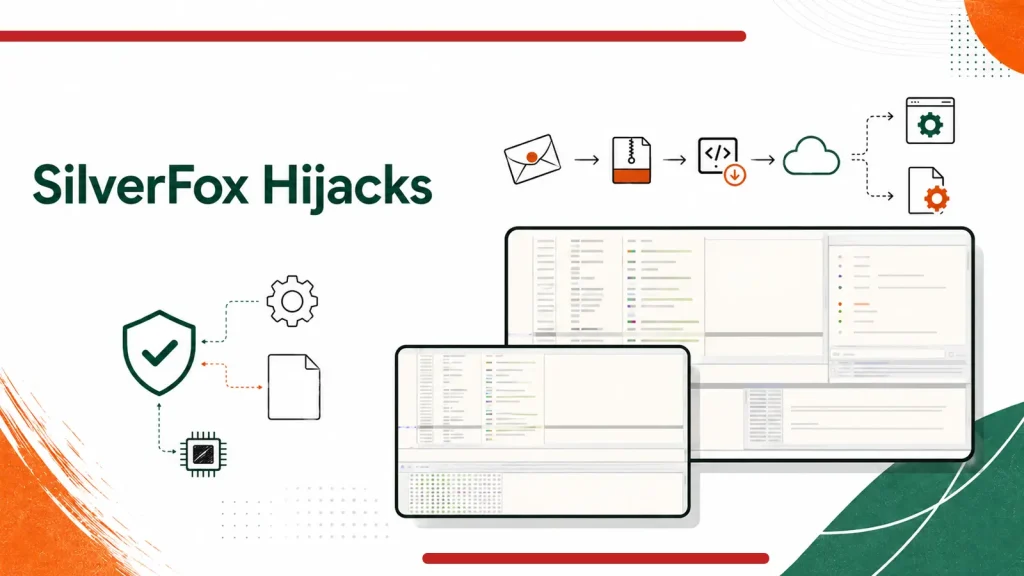
SilverFox Hijacks Trusted Software and Kernel Drivers to Disable Security Tools
Unmasking SilverFox: How Adversaries Hijack Trusted Software to Cripple Security Defenses
The landscape of cyber threats continuously evolves, with attackers developing increasingly sophisticated methods to bypass robust security measures. A recent campaign by the threat actor SilverFox exemplifies this, demonstrating a disturbing trend: the malicious leveraging of legitimate software and kernel drivers to disable security tools and maintain persistence. This analysis delves into SilverFox’s tactics, offering insights into their operational methodology and crucial recommendations for defense.
SilverFox’s Deceptive Entry: The Fake Invoice Lure
The initial vector for SilverFox’s attacks often exploits human trust through well-crafted social engineering. In a campaign targeting a Japanese industrial manufacturer, the entry point was a seemingly innocuous email. This email, designed as a fake invoice, enticed the recipient to download a malicious ZIP archive. Crucially, this archive was hosted on services that appear legitimate, lending an air of authenticity to the deceptive ploy. This method of using trusted platforms for distribution helps bypass initial email and web filtering mechanisms, showcasing a calculated effort to blend in with legitimate traffic.
Hijacking Trust: The Kernel Driver Exploitation
What sets SilverFox apart is its adeptness at exploiting the very mechanisms designed to ensure system integrity. Instead of introducing entirely new, easily detectable malware, SilverFox abuses trusted software and, critically, kernel drivers. The core of this technique involves loading malicious components without altering the signed, legitimate application itself. This bypasses many traditional endpoint detection and response (EDR) systems that rely on integrity checks of signed binaries.
By manipulating how legitimate software interacts with the operating system at a low level (the kernel), SilverFox can:
- Disable Security Tools: Gain sufficient privileges to shut down or cripple antivirus software, EDR agents, and other security monitoring tools. This creates a blind spot for the attacker, allowing them to operate undetected.
- Achieve Persistence: Establish a foothold that survives reboots, making their removal significantly more challenging.
- Evade Detection: The malicious activity is masked by the legitimate processes and drivers it hijacks, making it harder to differentiate from normal system operations.
While specific CVEs for the kernel driver exploitation used by SilverFox were not detailed in the source, this tactic often leverages known vulnerabilities or misconfigurations in legitimate drivers. For instance, vulnerabilities like CVE-2022-26168 or CVE-2023-38035 (though not directly linked to SilverFox, illustrate how legitimate driver flaws can be abused for privilege escalation or security product disabling) highlight the potential attack surface.
Remediation Actions: Fortifying Your Defenses Against SilverFox
Defending against advanced threat actors like SilverFox requires a multi-layered approach that addresses both initial compromise and post-exploitation tactics. Focusing on prevention, detection, and rapid response is paramount.
- Strengthen Email Security:
- Implement robust anti-phishing solutions with advanced attachment scanning and URL sandboxing.
- Educate users on identifying phishing attempts, emphasizing vigilance against unsolicited invoices or urgent requests, especially from external senders.
- Enforce DMARC, DKIM, and SPF records to authenticate legitimate email sources and block spoofed messages.
- Endpoint Detection and Response (EDR) Enhancement:
- Deploy EDR solutions capable of behavioral analysis, looking for anomalous process execution, unexpected driver loading, and attempts to tamper with security software.
- Regularly update EDR signatures and leverage threat intelligence feeds to detect known SilverFox indicators of compromise (IoCs).
- Configure EDR to monitor kernel-level activities and alert on suspicious driver installations or modifications.
- Application Whitelisting and Control:
- Implement application whitelisting to restrict the execution of unauthorized software and drivers. This significantly reduces the attack surface for malicious code.
- Regularly audit approved applications and drivers for known vulnerabilities.
- Patch Management:
- Maintain a rigorous patch management program for all operating systems, applications, and hardware drivers. Exploitable vulnerabilities in legitimate drivers are a common vector for this type of attack.
- Least Privilege Principle:
- Enforce the principle of least privilege for all users and services. Restrict administrative rights to only those who absolutely require them.
- Utilize privileged access management (PAM) solutions to control and monitor access to sensitive systems.
- Network Segmentation:
- Segment networks to limit lateral movement if a compromise occurs. This can prevent attackers from spreading from a compromised workstation to critical servers.
- Regular Backups and Recovery Plans:
- Implement a comprehensive backup strategy with immutable backups to facilitate recovery in the event of a successful attack.
- Test recovery plans regularly to ensure their effectiveness.
The Ongoing Battle: Staying Ahead of Adversaries
SilverFox’s campaign underscores a critical shift in adversary tactics: a move towards abusing trusted system components rather than relying solely on novel malware. By masquerading malicious activity within legitimate processes and kernel drivers, they aim to bypass traditional security defenses that focus on signature-based detection. Organizations must therefore evolve their security strategies to include advanced behavioral analysis, comprehensive application control, and stringent privilege management to effectively counter such sophisticated threats. Staying informed about emerging threats and continuously adapting defenses is not merely an option; it is a necessity in the persistent cybersecurity arms race.




