
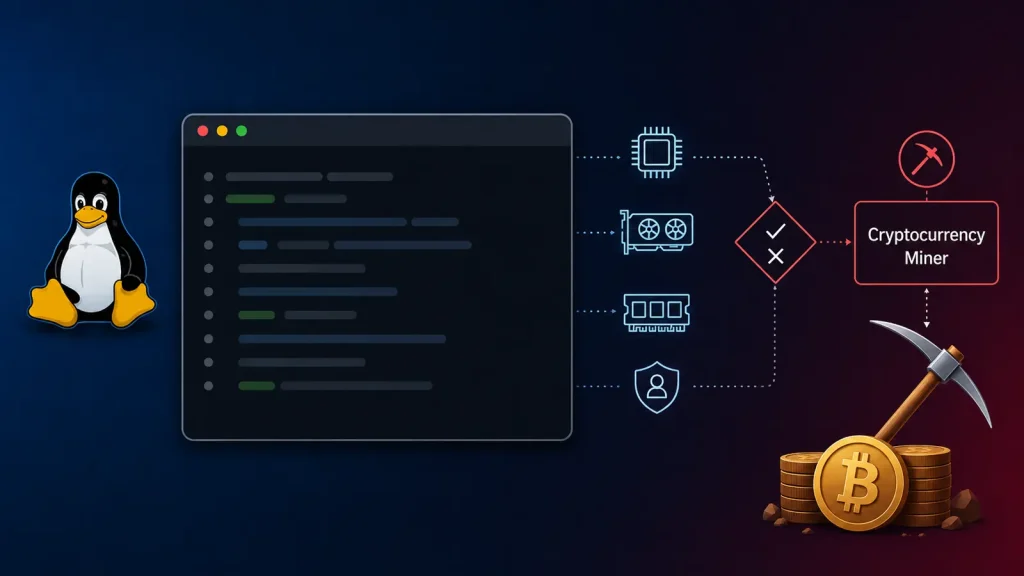
SSH Bot Profiles Linux CPU, GPU and RAM Before Deploying Cryptocurrency Miner
The silent login, the meticulous system scan, then the vanishing act. This isn’t a ghost in the machine; it’s a sophisticated SSH bot, recently observed targeting Linux systems. Instead of immediately dropping a visible payload, this threat meticulously profiles a system’s CPU, GPU, and RAM before seemingly walking away. While its initial behavior appears benign, cybersecurity analysts interpret this as a highly calculated precursor to cryptocurrency mining operations, carefully selecting optimal hardware for maximum illicit profit.
The Stealthy Reconnaissance: What the SSH Bot Does
This newly identified SSH bot distinguishes itself through its preliminary reconnaissance phase. Unlike many brute-force SSH attacks that aim for immediate compromise and payload deployment, this bot prioritizes information gathering. Upon gaining unauthorized access to a Linux host, it executes commands to ascertain critical system specifications:
- CPU Identification: It checks the type and number of CPU cores, crucial for understanding potential hashing power.
- GPU Analysis: Information about integrated or dedicated graphics processing units is gathered, as GPUs are often significantly more efficient for certain cryptocurrency mining algorithms.
- RAM Assessment: Memory capacity and speed are profiled, impacting the performance and stability of mining operations.
The striking aspect is its subsequent departure without deploying any readily identifiable malware or cryptocurrency miner. This “probe and wait” strategy suggests a more advanced threat actor who is not interested in every compromised system, but only those that meet specific profitability thresholds for their mining endeavors. This selective deployment minimizes the bot’s footprint on less lucrative targets, reducing the chances of early detection.
Why Profiling Matters for Cryptocurrency Mining Operations
Cryptocurrency mining, particularly for coins like Monero (often CPU-mined) or Ethereum (GPU-mined, though transitioning), is a resource-intensive process. The profitability directly correlates with the computational power available. A bot that profiles system hardware before deployment gains several strategic advantages:
- Optimized Resource Allocation: Attackers can deploy their miners to systems with the highest potential hash rates, maximizing their illicit gains.
- Reduced Detection Risk: Avoiding deployment on underpowered or unsuitable systems prevents unnecessary resource consumption and potential performance degradation that could alert legitimate users.
- Targeted Malware Deployment: The bot can download specific mining software optimized for the detected hardware architecture, ensuring maximum efficiency.
- Evasion of Security Measures: By not immediately dropping a payload, it bypasses security solutions that primarily focus on detecting known malware signatures upon initial compromise.
Remediation Actions: Protecting Your Linux Systems
Given the stealthy nature of this SSH bot, a multi-layered security approach is essential for protecting Linux infrastructure.
- Strong SSH Authentication: Implement strong, complex passwords and, ideally, move to SSH key-based authentication with passphrases. Disable password-based authentication entirely if possible.
- Principle of Least Privilege: Ensure that SSH users have only the necessary permissions. Avoid root login via SSH.
- Regular Patching and Updates: Keep your operating system and all software, especially SSH daemons (like OpenSSH), up to date. While this specific bot doesn’t exploit a single known CVE, unpatched vulnerabilities are common entry points. For instance, ensuring your OpenSSH is patched against issues like those that might lead to authentication bypasses (though none directly linked to this bot, general hygiene is critical) is crucial. Always check the CVE-2023-25136 for recent OpenSSH vulnerabilities.
- Firewall Configuration: Restrict SSH access to known, trusted IP addresses using tools like
ufworiptables. Consider changing the default SSH port (22) to a non-standard port, though this is primarily an obscurity measure. - Intrusion Detection Systems (IDS/IPS): Deploy network-based and host-based IDS to monitor for unusual SSH login attempts, brute-force attacks, or suspicious command execution post-login.
- Logging and Monitoring: Implement robust logging for SSH access attempts and system activities (e.g.,
auth.log,syslog). Use centralized log management tools (SIEM) to detect anomalies. - Multi-Factor Authentication (MFA): Where feasible, enable MFA for SSH access to add an extra layer of security.
Tools for Detection and Mitigation
Leveraging appropriate security tools can significantly enhance your defensive posture against threats like this SSH bot.
| Tool Name | Purpose | Link |
|---|---|---|
| Fail2Ban | Detects and blocks brute-force SSH attacks by dynamically updating firewall rules. | https://www.fail2ban.org/wiki/index.php/Main_Page |
| Lynis | Audits system hardening and compliance, identifying potential security weaknesses. | https://cisofy.com/lynis/ |
| OSSEC HIDS | Host-based Intrusion Detection System for log analysis, file integrity monitoring, and rootkit detection. | https://www.ossec.net/ |
| ELK Stack (Elasticsearch, Logstash, Kibana) | Centralized logging, analysis, and visualization for detecting anomalies and security events. | https://www.elastic.co/elastic-stack/ |
| OpenSCAP | Automated security compliance and vulnerability management for Linux systems. | https://www.open-scap.org/ |
Conclusion
The emergence of SSH bots that perform detailed system profiling before deploying cryptocurrency miners underscores an evolving threat landscape. Attackers are becoming more strategic, moving beyond crude indiscriminate attacks to targeted, profit-driven operations. Organizations and individual users alike must prioritize robust SSH security, regular patching, and continuous monitoring to defend against these increasingly sophisticated threats. The best defense remains a proactive and layered approach to cybersecurity.




