
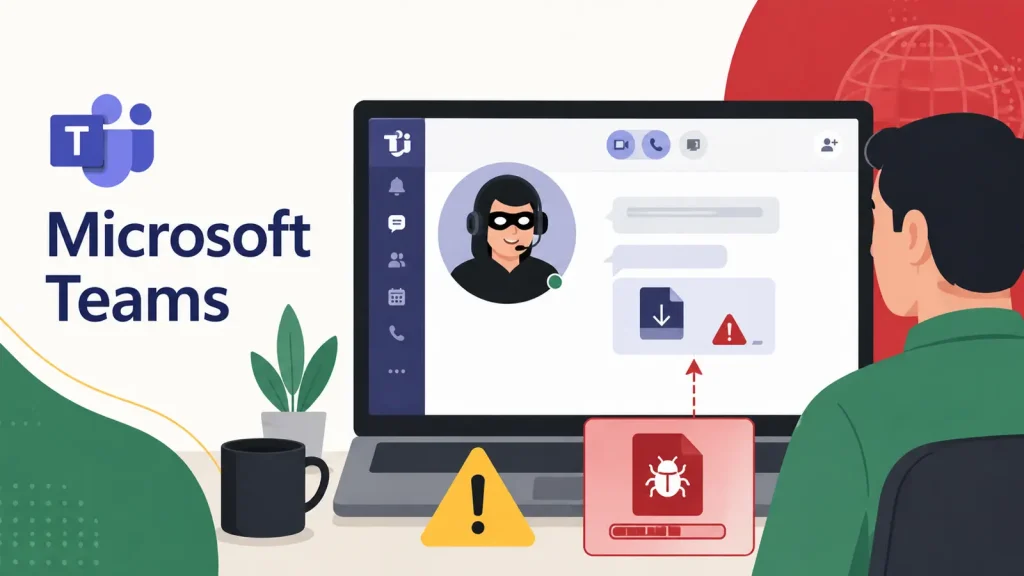
SynkLoader Mimic as IT Support Personnel Attacking Users Via Microsoft Teams
Imagine this: a routine message pops up on your Microsoft Teams, seemingly from IT support. It’s a familiar scenario, right? You trust your IT department, so when they ask you to install a quick fix for a persistent issue, you probably wouldn’t hesitate. This seemingly innocuous interaction is precisely what cybercriminals are exploiting in a sophisticated campaign involving SynkLoader, turning everyday IT support into a backdoor for malware delivery.
This isn’t about exploiting a software flaw in Teams itself. Instead, it’s a cunning psychological attack, leveraging human trust and the perceived authority of IT personnel to trick users into installing malicious software. As reported by Cyber Security News, the SynkLoader campaign highlights a growing trend: social engineering tactics that bypass technical defenses by targeting the weakest link – the human element.
The SynkLoader Impersonation Tactic
The core of this campaign lies in its deceptive simplicity. Attackers impersonate legitimate IT support staff, initiating conversations with targets via Microsoft Teams messages. These interactions are often framed as urgent or necessary to resolve a common IT problem, such as a software glitch or a security update. The goal is to establish a sense of urgency and authority, convincing the user that they are indeed speaking with their own IT department.
This initial contact often leads to instructions for the user to download and execute a “fix” – which is, in reality, the SynkLoader malware. The attackers are not relying on a vulnerability in Microsoft Teams but rather on the user’s trust and willingness to follow instructions from what they perceive as an authorized source. This makes it a particularly insidious form of attack, as traditional security measures focused solely on network or application vulnerabilities might not flag the initial interaction.
Vishing: The Voice Phishing Component
Beyond text-based Teams messages, the campaign also incorporates “vishing,” or voice phishing. This adds another layer of realism and pressure. A phone call, seemingly from IT support, can be even more convincing than a text message, especially if the attacker has gathered some preliminary information about the target or their organization. The urgency conveyed through a live voice can override a user’s caution, leading them to download and run the malicious payload without proper verification.
Vishing campaigns are notoriously difficult to detect with automated systems, as they leverage human interaction and social engineering. The attacker’s ability to mimic professional language and an understanding of common IT issues can easily fool an unsuspecting employee, making them an unwitting accomplice in their own compromise.
SynkLoader: A Gateway for Further Attacks
Once SynkLoader successfully infiltrates a system, it acts as a primary loader for other, more dangerous malware. This often includes information stealers, ransomware, or remote access Trojans (RATs). The initial compromise is rarely the end goal; it’s merely the first step in a multi-stage attack designed to exfiltrate sensitive data, gain persistent access to the network, or deploy destructive payloads.
The implications of such an infection are severe, ranging from data breaches and financial losses to operational disruptions and reputational damage. The ease with which SynkLoader can be deployed through social engineering makes it a significant threat to organizations of all sizes.
Remediation Actions
Combating attacks that leverage social engineering requires a multi-faceted approach, combining technical controls with robust security awareness training. While there isn’t a specific CVE for this social engineering tactic itself, the underlying principle of tricking users into executing malware is a perennial threat.
- Implement Strong Multi-Factor Authentication (MFA): Even if credentials are stolen, MFA can significantly hinder an attacker’s ability to gain unauthorized access.
- Conduct Regular Security Awareness Training: Educate employees on social engineering tactics, including phishing, vishing, and impersonation. Emphasize verifying the identity of IT support personnel through established, out-of-band channels.
- Establish Clear Communication Protocols for IT Support: Define and communicate official channels for IT support to contact users. Ensure employees understand that IT will never ask them to download executable files directly from a chat message or an unverified link.
- Deploy Advanced Endpoint Detection and Response (EDR) Solutions: EDR tools can help detect and block the execution of suspicious files, even if they are initiated by a user. They can also identify post-exploitation activities.
- Implement Email and Chat Security Filters: While this campaign bypasses some traditional email filters, robust chat security solutions can help identify and flag suspicious messages within collaboration platforms like Microsoft Teams.
- Principle of Least Privilege: Ensure users only have the necessary permissions to perform their job functions. This limits the potential damage an attacker can inflict even if they compromise a user account.
- Regularly Back Up Data: In the event of a successful ransomware attack or data corruption, having reliable backups is crucial for recovery.
Detection and Mitigation Tools
While no single tool can prevent all social engineering, a layered approach using various security solutions can significantly enhance an organization’s defensive posture against threats like SynkLoader.
| Tool Name | Purpose | Link |
|---|---|---|
| Microsoft Defender for Endpoint | Endpoint Detection and Response (EDR) and Next-Gen Antivirus | https://www.microsoft.com/en-us/security/business/microsoft-365-defender |
| CrowdStrike Falcon Insight | Endpoint Detection and Response (EDR) and Threat Intelligence | https://www.crowdstrike.com/products/endpoint-security/falcon-insight-edr/ |
| KnowBe4 Security Awareness Training | Phishing, Vishing, and Social Engineering Training | https://www.knowbe4.com/ |
| Proofpoint Targeted Attack Protection | Email and Cloud Security, including Threat Protection for collaboration tools | https://www.proofpoint.com/us/products/advanced-threat-protection |
| Okta Adaptive MFA | Multi-Factor Authentication (MFA) and Identity Management | https://www.okta.com/products/adaptive-mfa/ |
Key Takeaways
The SynkLoader campaign exploiting Microsoft Teams via IT support impersonation underscores the critical need for robust human firewalls. Technical defenses are essential, but they are not sufficient against determined attackers leveraging social engineering. Organizations must prioritize comprehensive security awareness training that empowers employees to recognize and report suspicious activity. Verifying identities through established channels, implementing strong MFA, and deploying advanced endpoint protection are vital layers in defending against these evolving threats. The vigilance of every employee is the front line in preventing these sophisticated psychological attacks from compromising organizational security.




