
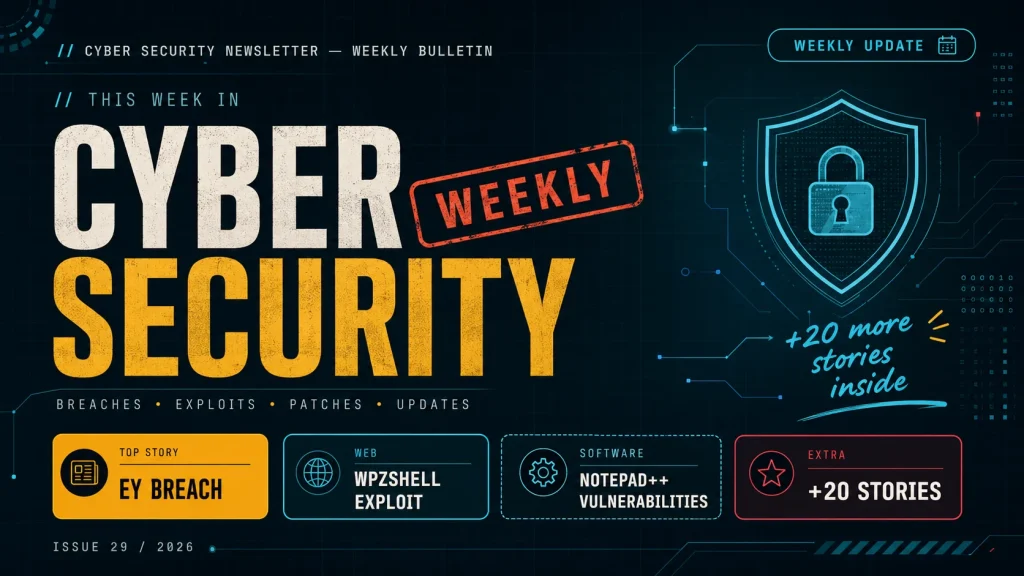
Weekly Cyber Security Newsletter Bulletin – EY Breach, Wpzshell Exploit, Notepad++ Flaws +20 Stories
The digital landscape is a relentless battleground, and this week’s cybersecurity bulletins drive that point home with stark clarity. From compromised identity systems to fundamental productivity tools, no corner of our technological infrastructure appears immune. The sheer volume of vulnerabilities being addressed, including actively exploited zero-days, paints a sobering picture of persistent and evolving threats. Understanding these breaches and weaknesses is not merely academic; it’s essential for fortifying our defenses against an increasingly sophisticated adversary.
Microsoft’s July Patch Tuesday: A Torrent of Vulnerabilities
Microsoft’s July Patch Tuesday updates brought a staggering number of fixes, approximately 570 in total. This isn’t just a record; it’s a testament to the continuous discovery and necessary remediation of flaws within their vast ecosystem. Among these, two critical zero-day vulnerabilities stand out, as they were already being actively exploited in the wild at the time of the patch release. Attackers aren’t waiting for patches; they’re actively probing and exploiting weaknesses as soon as they’re discovered or developed. These zero-days targeted:
- SharePoint Server: CVE-2023-38183, a critical remote code execution vulnerability, allowing attackers to execute arbitrary code on vulnerable SharePoint servers.
- Active Directory Federation Services (AD FS): CVE-2023-35384, an elevation of privilege vulnerability that could allow an attacker to gain SYSTEM privileges on a compromised AD FS server.
Remediation Actions: Microsoft Patch Tuesday
- Immediate Patching: Prioritize the deployment of all July Patch Tuesday updates, especially those addressing the zero-day vulnerabilities in SharePoint Server and AD FS.
- Vulnerability Management: Implement a robust vulnerability management program that includes regular scanning and patching cycles for all Microsoft products.
- Monitoring: Enhance monitoring for unusual activity on SharePoint and AD FS servers, as exploitation attempts often leave traces.
- Network Segmentation: Isolate critical systems like AD FS and SharePoint to limit lateral movement in case of a breach.
The EY Breach: A Supply Chain Conundrum
The recent breach at EY underscores the pervasive threat of supply chain attacks. While specific details often remain under wraps, such incidents typically highlight how a weakness in one organization can propagate risks throughout an entire ecosystem of clients and partners. Big Four firms like EY handle vast amounts of sensitive client data, making them prime targets for sophisticated threat actors. This type of breach often originates from:
- Third-Party Vendor Exploits: A vulnerability in a software or service provided by a vendor used by EY.
- Phishing/Social Engineering: Targeted attacks against EY employees to gain initial access.
- Misconfigured Systems: Overlooked security gaps in cloud environments or internal infrastructure.
Remediation Actions: Supply Chain Security
- Vendor Risk Management: Implement a rigorous vendor assessment program, including security audits and contractual obligations for robust cybersecurity practices.
- Supply Chain Mapping: Understand and map all third-party dependencies to identify potential points of failure.
- Incident Response Planning: Develop and test incident response plans specifically for supply chain disruptions, ensuring clear communication protocols with affected partners.
- Continuous Monitoring: Monitor network traffic and activity for anomalies that may indicate unauthorized access originating from a compromised supply chain partner.
Wpzshell Exploit: A Persistent Threat to Web Servers
The “Wpzshell” exploit refers to a web shell that provides persistent remote access to compromised web servers. Web shells are often uploaded after an initial compromise, typically through vulnerabilities like file upload flaws, SQL injection, or misconfigured applications. Once installed, Wpzshell allows attackers to:
- Execute arbitrary commands on the server.
- Upload and download files.
- Manipulate databases.
- Escalate privileges.
- Maintain a backdoor even if the initial vulnerability is patched.
The danger of web shells lies in their stealth and persistence. They can go undetected for extended periods, allowing attackers to operate freely within a compromised environment.
Remediation Actions: Detecting and Mitigating Web Shells
- Regular File Integrity Monitoring (FIM): Implement FIM tools to detect unauthorized changes to web server files.
- Web Application Firewalls (WAF): Deploy WAFs to detect and block common web-based attack vectors that lead to web shell uploads.
- Endpoint Detection and Response (EDR): Utilize EDR solutions to monitor server activity for suspicious processes or command execution.
- Secure File Uploads: Enforce strict validation and sanitization for all file uploads, restricting file types and employing antivirus scanning.
- Antivirus/Anti-Malware Scans: Conduct regular, deep scans of web server directories for known web shell signatures.
| Tool Name | Purpose | Link |
|---|---|---|
| ClamAV | Open-source antivirus engine for detecting web shells and malware. | https://www.clamav.net/ |
| OSSEC HIDS | Host-based Intrusion Detection System with FIM capabilities. | https://www.ossec.net/ |
| ModSecurity | Open-source Web Application Firewall (WAF) for proactive threat protection. | https://www.modsecurity.org/ |
| LMD (Linux Malware Detect) | Signature-based malware scanner for Linux systems, effective against web shells. | https://www.rfxn.com/projects/linux-malware-detect/ |
Notepad++ Flaws: The Risk in Ubiquitous Software
Even widely used, seemingly innocuous productivity tools like Notepad++ aren’t immune to security flaws. Software with a massive user base becomes an attractive target for attackers, as a single vulnerability can impact millions. While specific CVEs for recent Notepad++ flaws weren’t detailed in the provided source, common vulnerabilities in such applications can include:
- Buffer Overflows: Malformed input leading to memory corruption and potential code execution.
- Directory Traversal: Allowing access to restricted files through manipulated paths.
- Cross-Site Scripting (XSS): If the application handles web content, inputs could lead to script execution.
- Arbitrary File Write/Read: Exploiting features to read or write files outside intended directories.
These flaws, if exploited, could lead to data theft, system compromise, or the execution of malicious code on a user’s machine.
Remediation Actions: Securing Desktop Applications
- Keep Software Updated: Regularly check for and apply updates to all installed software, including productivity tools like Notepad++.
- Principle of Least Privilege: Run applications with the minimum necessary user privileges.
- Application Whitelisting: Implement application whitelisting to prevent unauthorized executables from running.
- Endpoint Security: Ensure endpoint protection (antivirus, EDR) is active and up-to-date on user workstations.
The Broader Landscape: 20+ Additional Stories and Beyond
The “20+ stories” mentioned in the bulletin highlight the enormous scale of weekly cybersecurity incidents. This volume suggests a diverse range of attack vectors and targets, indicating that organizations must adopt a multifaceted defense strategy. The types of incidents often include:
- Ransomware Campaigns: Continual evolution of ransomware gangs and their techniques.
- Phishing and Social Engineering: Persistently effective methods for initial access.
- Cloud Service Misconfigurations: Errors in cloud setups leading to data exposure.
- IoT Vulnerabilities: Exploitable weaknesses in connected devices.
- Critical Infrastructure Attacks: State-sponsored or sophisticated attacks targeting essential services.
Key Takeaways for a Resilient Defense
This week’s cybersecurity news reinforces several critical points for any organization striving for robust security:
- Patch Management is Paramount: Proactive and timely patching, especially for known exploited vulnerabilities, is non-negotiable.
- Supply Chain Security Demands Attention: Your security is only as strong as your weakest link, which often lies within your third-party ecosystem.
- Endpoint and Server Hardening: Every system, from personal productivity tools to critical servers, requires vigilant protection and monitoring.
- Zero-Day Exploits are a Reality: Assume attackers are already trying to breach your systems using unknown flaws, necessitating defense-in-depth and advanced threat detection.
- Continuous Vigilance: The threat landscape is dynamic. Regular security assessments, threat intelligence consumption, and adaptable defense strategies are essential for resilience.




