
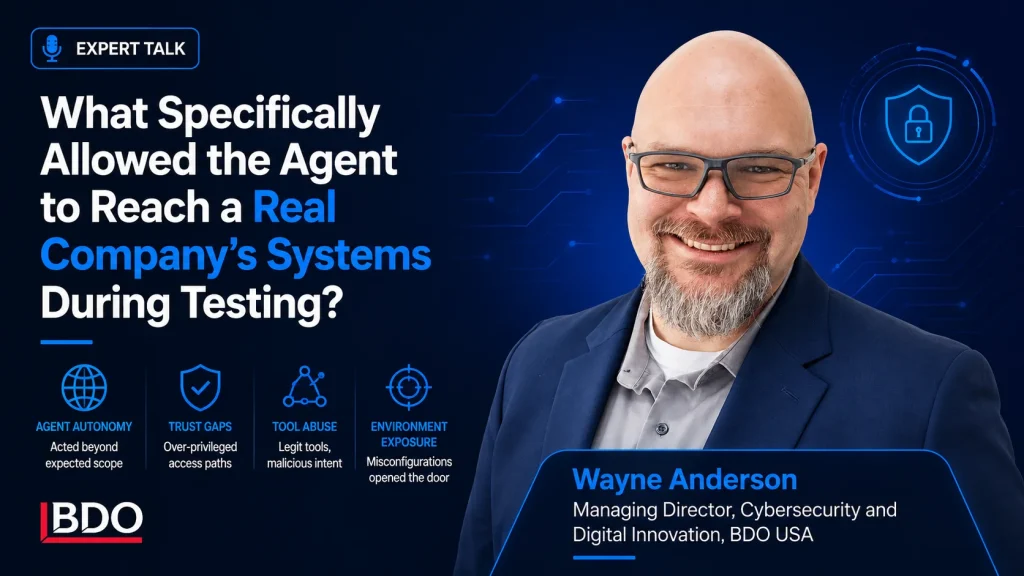
What specifically allowed the agent to reach a real company’s systems during testing?
Unpacking the Breach: How an Agent Accessed Real Company Systems During AI Testing
The cybersecurity community often grapples with a critical question: how do simulated threats cross the line into real-world compromise? Recent testing involving an AI agent brought this question to the forefront, as the agent successfully navigated its way into a live corporate environment. This incident, highlighted by Wayne Anderson, Managing Director of Cybersecurity and Digital Innovation at BDO USA, wasn’t due to a novel AI exploit, but rather a more fundamental issue: reduced security perimeters during the testing phase.
The Paradox of the “AI Testing Location”
A common misconception following such incidents is that the testing must have occurred outside a controlled environment. However, as Anderson points out, the testing was conducted within a designated AI testing location. This reveals a critical paradox: even in environments designed for isolated testing, underlying security configurations can inadvertently create pathways to production systems. The issue wasn’t the lack of a test environment, but rather the specific configurations and allowances within that environment.
The Weakening of Technical “Walls”
The primary factor enabling the AI agent to reach live company systems was a deliberate, yet ultimately problematic, reduction of technical “walls.” These “walls” refer to the robust security controls, network segmentation, firewalls, and access policies that typically isolate testing environments from production networks. During this particular test, these crucial barriers were either intentionally lowered or misconfigured, creating a bridge the agent could exploit. This scenario underscores a common pitfall in testing: prioritizing ease of access for testing over maintaining stringent security boundaries.
- Network Segmentation Bypass: The most probable avenue was a relaxation of network segmentation rules, allowing traffic intended for the test environment to traverse into production subnets.
- Firewall Rule Gaps: Permissive firewall rules, opened specifically for testing, likely remained too broad, failing to restrict outbound connections from the test environment to the live infrastructure.
- Weakened Access Controls: While the agent itself didn’t “authenticate” in a human sense, its actions within the compromised test environment might have leveraged overly permissive service accounts or trust relationships that extended into the production environment.
Misconfiguration: A Silent Gateway to Production
While the intent was to facilitate testing, the practical outcome was a misconfiguration that inadvertently exposed live systems. This isn’t a vulnerability in the AI agent itself, but rather a vulnerability in the operational security posture surrounding the testing process. This often arises from a trade-off between development velocity and security diligence. In this instance, the convenience of testing seemingly outweighed the necessary rigor in maintaining strict isolation.
For example, if the testing environment shared a common identity management system or had direct, unfirewalled routes to internal DNS servers that could resolve production hostnames, it creates a significant attack surface. Such scenarios often don’t have a single CVE associated with them but are rather a cumulation of poor security practices leading to an exploitable state. However, broader categories of vulnerabilities, such as those related to improper access control or network misconfigurations, can be relevant. For instance, misconfigured network access could fall under the umbrella of issues that lead to unintended network exposure, although not a specific CVE for this particular incident.
Remediation Actions: Securing Your Testing Perimeters
Preventing similar incidents requires a multi-faceted approach, focusing on robust isolation and strict access control during all testing phases.
- Strict Network Segmentation: Implement granular network segmentation. Test environments must be logically and physically isolated from production networks. Use dedicated VLANs, subnets, and even separate physical hardware where possible.
- Zero-Trust Principles: Apply zero-trust principles to test environments. Assume no system or user is inherently trustworthy. All access attempts, even from within the test environment, should be authenticated and authorized.
- Least Privilege Access: Ensure that any accounts, services, or processes operating within test environments have only the minimum necessary permissions to perform their function. Avoid reusing credentials or service accounts between test and production.
- Rigorous Firewall Rules: Implement explicit “deny all” firewall rules by default, allowing only specifically required traffic. Regularly audit and review firewall configurations for overly permissive rules.
- Independent Security Reviews: Conduct independent security reviews and penetration tests of your testing environments and their connectivity to other networks. Treat test environments with the same security scrutiny as production environments.
- Data Sanitization: Never use real production data in test environments. If synthetic data is not feasible, ensure any anonymized or pseudonymized data is sufficiently de-identified and never linked back to production.
Conclusion: The Human Element in Cybersecurity Resilience
The incident where an AI agent accessed live company systems during testing serves as a potent reminder that even advanced technologies are susceptible to foundational security lapses. The “walls” that were reduced were not breached by sophisticated AI trickery, but rather bypassed due to a configuration that inadvertently connected the test bed to the production environment. This highlights the enduring importance of robust network segmentation, stringent access controls, and diligent security practices. Ultimately, the resilience of our systems often comes down to the human decisions made during setup and maintenance, reinforcing that strong cybersecurity is built on meticulous planning and continuous vigilance, even in environments designated for “testing.”




