
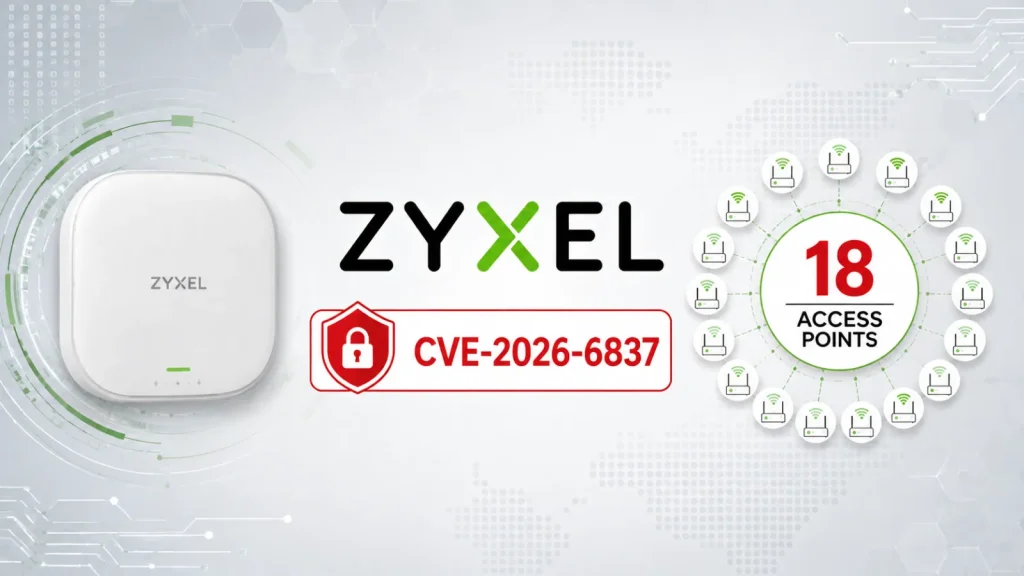
Zyxel Patches Command Injection Flaw in 18 Access Points Allowing Root OS Command Execution
Zyxel Patches Critical Command Injection Flaw in 18 Access Point Models: A Deep Dive
In the dynamic landscape of network security, vulnerabilities can emerge from unexpected corners, often with significant implications for organizations. Recently, Zyxel, a prominent provider of networking solutions, addressed a high-severity command injection vulnerability impacting a broad range of their wireless access point (AP) models. This flaw, tracked as CVE-2023-6837, presented a critical risk by allowing authenticated administrators to execute arbitrary operating-system commands with root privileges. Understanding the nature of this vulnerability and implementing timely remediation are paramount for maintaining a robust security posture.
Understanding CVE-2023-6837: The Command Injection Threat
The core of CVE-2023-6837 lies within the export-cgi component of Zyxel’s affected access points. Specifically, the vulnerability manifests during the PKCS#12 certificate export workflow. Command injection vulnerabilities occur when an application constructs a system command using user-supplied input without proper sanitization. If an attacker can inject malicious commands into this input, the application will execute them as part of the legitimate system command.
In this scenario, a threat actor with authenticated administrator access could craft a special input during the certificate export process. This malicious input would then be interpreted by the operating system as a command, leading to its execution. The critical aspect here is the potential for root operating-system command execution. Gaining root access provides an attacker with complete control over the device, allowing them to:
- Install malware or backdoors.
- Modify device configurations.
- Exfiltrate sensitive data.
- Launch further attacks within the network.
Security researcher Mina Nageh Salama is credited with discovering and reporting this significant flaw, enabling Zyxel to develop and release necessary patches.
Affected Zyxel Access Point Models
Zyxel has identified 18 wireless access point models as being vulnerable to CVE-2023-6837. While the specific list of all 18 models was not detailed in the provided source, it is crucial for organizations to consult Zyxel’s official security advisories for a comprehensive list and corresponding firmware updates. Generally, this wide range of affected devices underscores the broad impact of such vulnerabilities across product lines.
Remediation Actions and Best Practices
Addressing CVE-2023-6837 requires immediate action. The primary and most effective remediation is to update the firmware on all affected Zyxel access points.
- Firmware Updates: Zyxel has released specific firmware patches to address this vulnerability. Administrators must download and install the latest firmware versions for their respective AP models from the official Zyxel support website. This update will contain the necessary code fixes to prevent command injection.
- Review Access Point Configurations: Even after patching, it’s a best practice to review the configurations of your access points. Ensure that only necessary services are enabled and that administrative interfaces are not exposed to the public internet without strong authentication and access controls.
- Strong Authentication: Always enforce strong, unique passwords for administrative accounts on all network devices. Consider implementing multi-factor authentication (MFA) where available, even for local device access.
- Network Segmentation: Isolate management networks from general user networks. This limits the lateral movement an attacker could achieve even if they gain control of a single device.
- Regular Auditing and Monitoring: Implement regular security audits and continuous monitoring of network device logs for unusual activity. This can help detect attempts at exploitation or unauthorized access.
Tools for Detection and Mitigation
While direct detection of this specific command injection vulnerability often requires specific exploitation attempts, general security tools can assist in maintaining overall network security and identifying compromised devices.
| Tool Name | Purpose | Link |
|---|---|---|
| Nessus | Vulnerability scanning, identifying outdated firmware. | https://www.tenable.com/products/nessus |
| OpenVAS | Open-source vulnerability scanner for network devices. | http://www.openvas.org/ |
| Wireshark | Network protocol analyzer for detecting suspicious traffic patterns. | https://www.wireshark.org/ |
| Splunk (or similar SIEM) | Security Information and Event Management for log aggregation and anomaly detection. | https://www.splunk.com/ |
Conclusion
The discovery and subsequent patching of CVE-2023-6837 highlight the ongoing challenges in securing network infrastructure. Command injection flaws, especially those allowing root access, represent a significant threat vector. Zyxel’s prompt action in releasing firmware updates is commendable, but the responsibility now shifts to administrators to deploy these patches without delay. Proactive vulnerability management, coupled with robust security practices, remains the most effective defense against such sophisticated threats. Stay vigilant, update regularly, and secure your network endpoints.




